Review
Matthew Arnone: Let’s Be Friends
February 24, 2015On View
Right Window
February 4 - February 28, 2015 Solo Show“Fuck a fake friend / where my real friends at?” Drake barks rhetorically to conclude the chorus of DJ Khaled’s “No New Friends.” Indeed, “No New Friends” reaffirms a classic trope of friendship theory, epitomized in Aristotle’s apothegm that friends aren’t true friends until they’ve consumed a bushel of salt together. Today, of course, the stringent classical requirements for friendship, time and scarcity, have been replaced by instantaneity and abundance. While the quantity and quality of the content generated by these friendships is capable of producing knowledge, opportunities, and pleasure, the lack of distinctive depth can also make users feel quite lonely. This loneliness, this happiness, this intimacy and estrangement, are the key terms of Matthew Arnone’s remarkable Let’s Be Friends.
If there is no clearer sign of contemporary friendship than the proliferation of liking, Let’s Be Friends resembles the contemporary economy of our relationships: this work is promiscuous in who and how it courts, coy and sincere all at once. Let’s Be Friends is a collection of likable works that thematize liking and being liked. As a show, it invites the viewer to like the work and by extension their maker, who is the central figure of the images.
For me, the achievement of these works is the seamless appropriation and display of opposed, even contradictory affects. The paintings, drawings, prints, sculpture, and videos that comprise the show all represent Arnone himself, both his image and the letters of his name (in case there was any doubt). These self-portraits figure Arnone in explicitly or implicitly pathetic and abject positions, yet they are also celebratory and ridiculous. There is hardly a calculus to measure which countervailing mood prevails in any given piece.
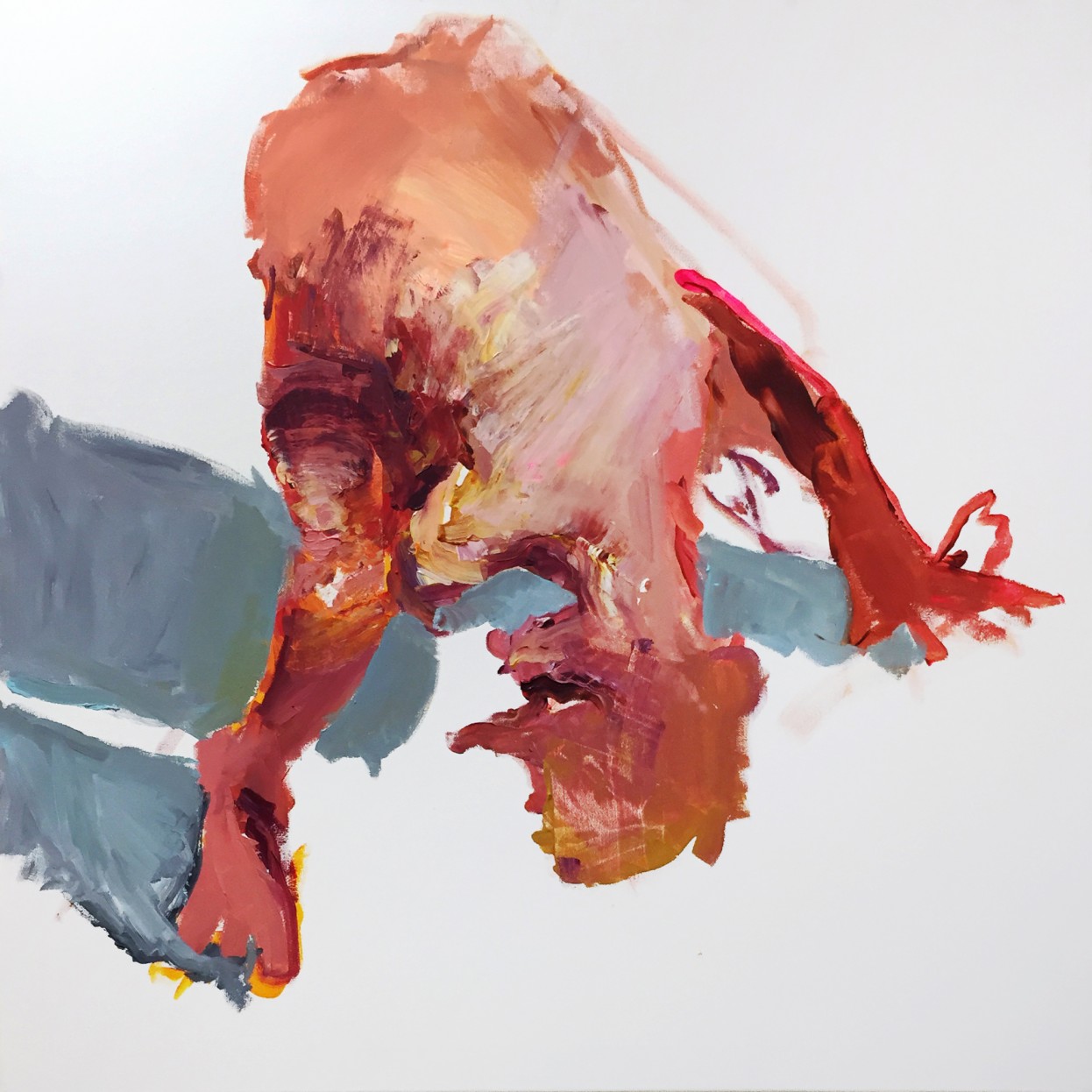 Matthew Arnone. Let Me Get That For You, 2015; Acrylic paint on canvas. Courtesy of the Artist.
Some of the works explicitly express sad passion and melodrama. In Let Me Get That For You (2015), the figure in the painting bows before the viewer on his knees. Thick acrylic paint gathers in density and intensity of color around the arms. These dual agents of obsequy become the feverish epicenters of this painting. The intensity of the abject and pathetic figure on his knees groveling for one little taste of your love is offset by the title, which exudes the casualness of someone picking up a dime you dropped.
In other pieces, figures appear almost joyous. It’s So Great, Thanks (2015) is ostensibly a smiling self-portrait with a cat. We might mistake the artist’s facial expression as one of simple gratitude and pleasure; but nothing in the cosmos of Let’s Be Friends is “simple.” The reddish flesh of the body is both giddy but also nervous, the gaping maw gapes a little too big and too much. Arnone’s painted avatar is utterly unreliable; the exhortation to be his friend always exhorts too much. The gladness starts to seem sort of sinister. Is he happy? Is he thankful? Does he think this is great?
Arnone’s painted avatar is utterly unreliable
In the statement that accompanies the show, Arnone describes these works in terms of the “oscillation between sincerity and facetiousness, love and fetish, confidant and sycophant.” These works materialize that process of oscillation. As a result, they are able to wildly miscode. Let’s Do This (2015) depicts Arnone as a leaping basketball player. With the fiery macho exhortation of the title and supposedly graceful mise–en–scène, the gesture might be read as the classic one in which a painter represents themselves in heroic role play. Rembrandt in armor, that sort of thing. Only this play is not really that heroic. The glory is undermined by the desperately clumsy and pained figure flailing around mid-jump.
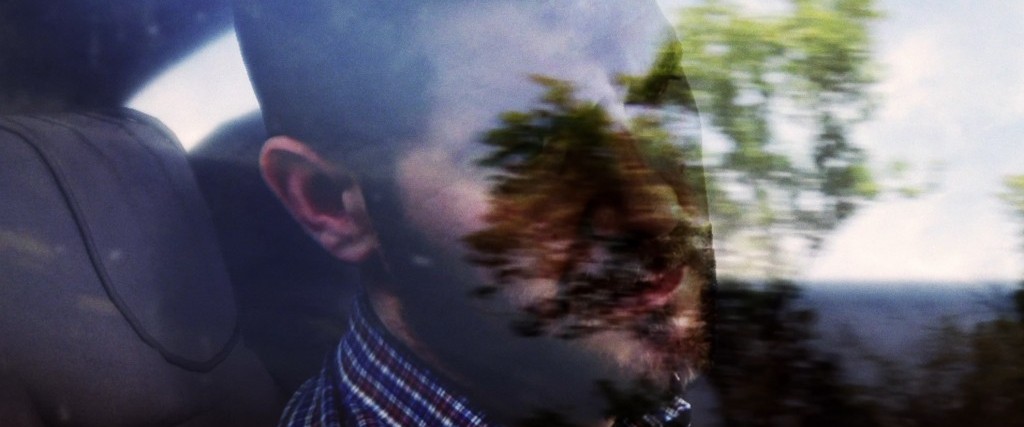
The simultaneous presence of opposite affects is exquisitely contextualized in I’ll Come With (2014), a five-minute video piece that purports to show Arnone sitting in a moving car, looking out the window. What we see for the duration is a video loop of the artist’s face, the reflection of passing trees and sky. The soundtrack consists of breezy inspirational rock loops available for purchase online. The guitars drone on but never resolve, never transition. Just like the landscape, which passes by but never really changes or gets anywhere. Arnone’s face is grave and disturbed, odd for a video whose title suggests the happy prospect of a festive car ride with a friend.
Taken as a whole, I’ll Come With evokes the opening credits of Friday Night Lights or the melodrama of an embarrassing pharmaceutical commercial. In the context of Let’s Be Friends, this piece heightens the sense that to welcome the call to be friends is to enter into a duplicitous contract, one productive of pleasures but always with a price.
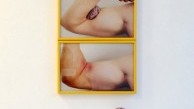
In the diptych of C-prints called Let’s Be Friends (2015), the perishability and mutability of friendship is imagined literally. The photograph on the left shows a neck and upper breast of an indeterminate subject, wearing a thin chain with a locket. Inside the locket is a picture of Arnone. This is the first and perhaps only inkling of reciprocated intimacy.
Let’s Be Friends calls for a reappraisal of what intimacy can and might mean for us.
Alas, the print on the right provides the post face. The same chest is shown, facing the one with the locket. But it’s no longer there. A slightly raised area of the skin where they had hung is discernible, as if the skin had healed over the skin where the wearer wore the pendant. I guess that’s something about friends—friendships can fade and disappear, but leave a mark. In this case, a literal scar.
Let’s Be Friends calls for a reappraisal of what intimacy can and might mean for us. As for Arnone, he is almost always represented as being alone in these scenes. The solitude of the figures is exacerbated by the desperation of the demand for our affection. This show is a hilarious and sad analysis of all we do for and because of love.
Matthew Arnone: Let’s Be Friends is on view at Right Window, in
San Francisco
, through February 28, 2015.