
3.14 / Review
From Mexico City: Zona Maco México Arte Contemporáneo
May 3, 2012On the morning I was leaving Mexico City, I saw the mountains for the first time. In the distance, I could just make out Popocatépetl between the billboards as my taxi rushed me to the airport. Popocatépetl is the world’s youngest volcano, which first erupted in the 1940s, and I could see a plume of ash issuing from its heights. I could not help but think of the rumbling beneath the earth as a metaphor for Mexico City’s rapidly expanding art world. The city is as populous as New York and as wide as Los Angeles, though there are probably not as many galleries there as there are in San Francisco. But it is on the rise. Long a place where the centralized government invested heavily in the arts, Mexico City has a new generation of foundations and private enterprises that has led to a groundswell in its art market and in the ambitions of the artists who reside in the city. During a recent visit to Zona Maco, the city’s annual art fair, the expansion of possibilities in the visual arts was palpable.
There is no way of getting around the fact that art fairs are fundamentally trade shows for high-end merchandise, but the advantage of visiting Mexico City during the fair is that all the local institutions and galleries show off, timing their openings and projects to capture everyone’s attention. Thanks to this confluence, I experienced a host of contemporary projects, though only a fraction of what was on offer. One can only do so much in four days.
More than a hundred booths were crammed cheek by jowl into a large exhibition hall on the edge of Mexico City, in the Centro Banamex. The fair was divided into four sections. The main exhibition included fifty-seven booths, representing fifteen galleries from Mexico and fourteen other countries. This cosmopolitan lot did not disappoint. There was a lot of strong work from locals and foreigners and while there were some surprises, there was also much that could be seen at any art fair. As one might expect, the focus was on Latin America, and some of my favorite discoveries were the cut-paper drawing by Miguel Ángel Rios at Gallery Luis Adelantado (Valencia, Spain) and the dramatic crumpled, hand-made reproduction of Diego Rivera’s Man, Controller of the Universe (1934) by Javier Arce at Gallery T20 (Murcia, Spain). There was also the New Propositions section, with younger galleries from all over, but most interesting for me were the galleries from other cities in Mexico, such as La Estación from Chihuahua. This space provided some compelling surprises, including artists who mixed regional craft traditions with conceptual art vernacular, such as Ariàn Dylan’s woven consumer goods.
The Zona Maco Sur section, curated by Patrick Charpenel, was for me the most exciting aspect. Like other art fairs, Zona Maco turned over some of its space to the presentation of single-artist, mini gallery exhibitions, and I was delighted to find a captivating project by Shilpa Gupta presented by Yvon Lambert of Paris. Two local galleries, Gaga Arte Contemporáneo and Galeria d’Arte Moderna, also offered strong presentations of
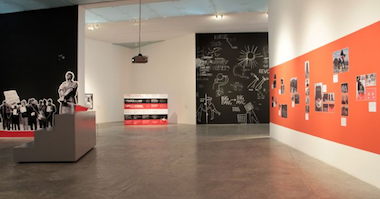
Andando hacia adelante, contando hacia atrás: Palestra Europa del Este, 2012; installation view, Museo Universitario de Arte Contemporáneo. Courtesy of Museo Universitario de Arte Contemporáneo, Mexico City.
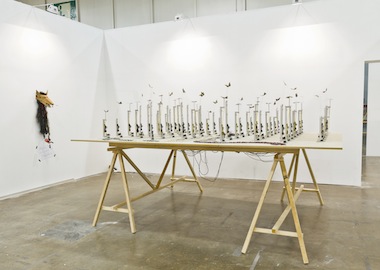
Fernando Palma Rodríguez. Tocihuapapalutzin (Our lady butterfly), 2012; microcontrollers, wood, aluminum; dimensions variable. Courtesy of the Artist and Gaga Fine Arts. Photo: Isaac Contreras.
the artists Fernando Palma Rodríguez and Diégo Perez, respectively. Finally, I was won over by a video from the Brazilian artist Eugenia Calvo, featuring a Dutch porcelain wonderland suffering an attack from mashed potatoes.
The city at large has been inundated with new museums in the past ten years, including the Museo Soumaya and, specifically for contemporary art, the Colección Jumex and the Museo Universitario de Arte Contemporáneo (MUAC). I visited the latter and experienced a series of engaging and expertly curated group and individual exhibitions. The exhibitions, such as Andando hacia adelante, contando hacia atrás: Palestra Europa del Este (Moving forward, counting backwards: Eastern Europe Palestra) and Extranjerías (Foreigners) were good enough to put the New Museum on alert. Also, long-standing exhibition spaces, such as the Palacio de Bellas Artes and the Colegio de San Ildefonso, have turned to presenting more contemporary art in recent years. Quodlibet, a small investigative project by Pablo Helguera, exposed some of the most fantastic aspects of the history of Bellas Artes and added a recitation of his own to this history. La lengua de Ernesto. Obras 1987–2011, an incredible and extensive exhibition by Ernesto Neto at San Ildefonso, invited everyone, including the nabobs of the art world, to cavort inside nylon-fabric structures and to try out fantastic prostheses. Though Neto’s work has been seen a lot in recent years, this mid-career retrospective breathed new excitement into his explorations of the senses. Even the Museo del Tequila y el Mezcal got in on the act with an exhibition of the work of Betsabeé Romero, a provocative artist who presented a variety of works and a clothed car, parked in the lively Plaza Garibaldi, that evokes the incredible vitality and rich nuance of Mexico City’s highly democratic car culture.
Outside of the fair, the galleries were able to give more space to many remarkable figures. In the new hot gallery zone, San Miguel Chapultepec, Kurimanzutto holds forth in the finest gallery complex I have visited anywhere. An exhibition by Gabriel Kuri spread across two spaces and demonstrated why this gallery has come to be seen as an international powerhouse. The work was conceptually rich and physically inventive in a way that reminded me of the excitement of SoHo in the 1980s. At LABOR, in a lovely new space that opened just in time for the fair, Pedro Reyes presented a rich and complex meditation on life and art.
I could not leave Mexico City without a little archaeological exploration, and my wishes were answered at the Templo Mayor, the unburied Aztec pyramid complex at the center of the city that displayed a newly discovered monumental sculpture long hidden under the city. Mexico City has one thing that you cannot find in New York or Los Angeles: thousands of years of cultural history under your feet. If the volcano is any sign, those subterranean historical forces are stirring and, combined with the seething energy above ground, this city’s cultural life history may soon boil over, or it might just explode.