
4.17 / Review
Your motion says you’re in the mood
June 13, 2013Thumbnail: Christopher Füllemann. Your motion says you're in the mood, 2013; installation view at n/a, Oakland. Courtesy of the Artist and n/a. Photo: Kristine Eudey.
It's plain that I spend my time on you too much.–Arthur Russell, “Your Motion Says”
________
For its inaugural exhibition, n/a, a new art space in Oakland, features a group of captivating and vibrant sculptures by the Swiss-born, Oakland-based artist Christopher Füllemann. His sculptures demonstrate a horror vacui: nearly every piece is thickly layered with paint, expandable foam, glossy tiles, or epoxy-covered sand. The strange shapes with their tantalizing finishes beg to be touched and explored. Two of the pieces are on casters, and three offer what appears to be seating. It is unsurprising, then, that n/a will host four separate events during the run of the exhibition. Acting as props, stage, and narrative, Füllemann’s sculptures create the perfect playground for poets, musicians, and other performers to further activate the space.
Your motion says you’re in the mood is an all-encompassing title. The five works in the show have no individual names; they exist as a constellation of objects made for the specific setting of n/a, the home of the show’s organizer, Nicholas Sung. Inside the white-walled and -floored street-level studio apartment, aspects of the home bleed into the gallery much in the way the gallery MacArthur B Arthur once operated in Kevin Clarke’s nearby storefront apartment. Pulled from an Arthur Russell song, the title of the show references the influence of Russell’s music on Füllemann’s life and practice while illustrating the mobile qualities of Füllemann’s works. Even the sculptures without casters have inherent motion: draped fabric coated with epoxy holds the shape of a form to which it once conformed, and brightly colored enamel pools on flat surfaces and hangs in perpetual drips above the floor. Füllemann’s sculptures are equal parts hardness and softness.
The first three pieces inside the front door feature actual greenery, which is not as unusual or as contemporary as one might think. In an article for the San Francisco Museum of Modern Art’s Open Space blog, the curator Arden Sherman writes about the “defoliation” of the art gallery. Where once potted plants were de rigueur in galleries, concern for the conditions surrounding increasingly valuable pieces of art led to their banishment by the mid-1980s. Sherman writes, “Perhaps paradoxically, in the very moment of plants’ eviction, artists began to incorporate living matter into their work.”1 While n/a is a remarkably white space, Füllemann’s plants seem less like a critique of a sterile gallery than a playful attempt at lending the sculptures the utilitarian purpose of extremely elaborate vases—and Sung’s verdant backyard is a perfect bookend to such sculptural plant life.
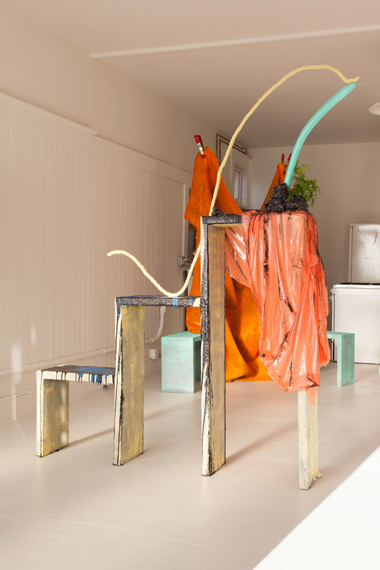 Christopher Füllemann. Your motion says you're in the mood, 2013; installation view, n/a, Oakland. Courtesy of the Artist and n/a. Photo: Kristine Eudey.
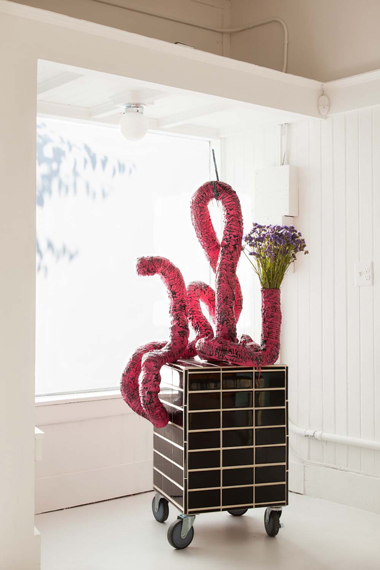 Christopher Füllemann. Your motion says you're in the mood, 2013; installation view, n/a, Oakland. Courtesy of the Artist and n/a. Photo: Kristine Eudey.
In one of these sculptures, a black-tiled box on casters acts as a pedestal for a squiggly tubular form that ends in a bouquet of papery statices. At its highest point, the pink-and-black tube is supported by a hook of black rope, which is frozen in space and ends after about five inches. What once required hoisting to defy gravity now resembles a magic trick. A similar illusion occurs in a large-scale sculpture in the back left corner of the gallery: two red-rubber-ended spring clamps seem to hold the corners of a giant orange-painted carpet pad aloft as it stiffly drapes over two turquoise benches. The verso shows that the clamps are actually latched onto wooden support beams. But knowing that doesn’t cause the magic to dissipate, mostly due to the attention Füllemann pays to the surfaces of this sculpture and the variety of colors and textures he achieves with little more than hardware-store goods and a few coats of paint. Repeatedly, the juxtaposition between identifiable elements (orange vinyl-coated chain) and not-so-easily-placed materials (something that appears to be athletic mesh) is what makes Füllemann’s pieces so tempting to touch.
In a final sweet note, an open door beckons viewers into the dark space of Sung’s highly organized closet, where a small projector and speakers play clips from Phill Niblock’s 1985 videos Terrace of Unintelligibility and Some Imaginary Far Away Type Things/AKA Lost in the Meshes. The close-up and darkly lit shots of Arthur Russell singing and playing cello are mesmerizing, even for those who are unfamiliar with the musician’s rich output. It is a curious choice, closeting the legendary gay artist in a gallery that states a focus on “the queer experience in contemporary art practice,” but perhaps it’s simply the best space in the gallery to project video.
The videos of Russell serve as a touchstone for Füllemann’s sculptural extrapolations, just as Russell can provide the guest performers with spiritual guidance. The poets Kevin Killian and Paul Ebenkamp, the vogue dancer Jocquese Whitfield, the opera singer Breanna Elyce Sinclaire, the neo-classical pop musician Karl Cronin, the cellist Teddy Rankin-Parker, and the drummer Daniel Pearce will host events throughout the duration of the exhibition and enjoy the enviable privilege of interacting with Füllemann’s corporeal sculptures.
Your motion says you’re in the mood is on view at n/a, in Oakland, through July 6, 2013.