
4.15 / Review
The Clock and Things I’ve Heard
May 4, 2013Things I’ve Heard
Christian Marclay
March 29 – May 25, 2013
Fraenkel Gallery
With perhaps the exception of Marina Abramović’s The Artist is Present (2010), it is hard to think of a single piece of art that has had more blockbuster appeal in recent years than Christian Marclay’s The Clock. Since debuting at London’s White Cube gallery in 2010, the 24-hour-long, ten-thousand-clip video collage of round-the-clock time references in film has played at more than a dozen locations from Moscow to San Francisco, where it is presently on view at the San Francisco Museum of Modern Art (SFMOMA). Wherever it goes, it draws huge crowds, bringing in not only contemporary art lovers but also film buffs and spectacle devotees of all sorts.
A work with this kind of popular appeal has the problematic capacity to eclipse the rest of any artist’s practice. Sure enough, SFMOMA’s installation of The Clock, which turns an entire exhibition area into an IKEA-couch-lined quasi-cinema, presents the work as a stand-alone monument. In the introductory wall text, the museum makes specific mention of only two other Marclay pieces, Telephones (1995) and Video Quartet (2002). Both of these are video collages cut from a cloth similar to that of The Clock—the first consists of telephone-call scenes from films, the second of cinematic musical performances—but at a much smaller scale (7 and 13 minutes long, respectively).
The more The Clock is separated from the rest of Marclay’s thirty-odd years of artistic practice, the more spectacular it becomes, taking on almost mythical status for its sheer massiveness. It took about three years for Marclay to put it together, even with the help of assistants to gather footage (a task that, of itself, would have been effectively impossible prior to a fairly recent state of digital storage capacity, accessibility, and editing). Spurred by such a wide-eyed view, our awe can easily give way to the feeling that The Clock is simply an inevitability of its historical moment. Made in an era characterized by an artistic zeitgeist of sampling and remixing, Marclay’s work emerges as the artful crest of a relatively banal wave of appropriation tactics that includes everything from hip-hop production to Nicolas Cage montages on YouTube.
This limited perspective overemphasizes the more superficial talking points about The Clock—namely, its length and method of production—and in so doing threatens to degrade our experience of the work. The Clock may stand to offer revelations of deeper, more lasting value, but if it does, they will likely be visible only in light of the subtle particularities of Marclay’s evolving, fascinatingly varied practice and artistic sensibility. We need a point of entry to The Clock that is neither the work itself nor its seeming direct predecessors, Telephones and Video Quartet.
Enter the exhibition Things I’ve Heard at Fraenkel Gallery: an unassuming array of about fifty snapshots, taken by Marclay between 1994 and 2009. Each photograph, in some way, contains a reference to music or sound—something that has been a recurring motif in the artist’s career since his early days as a turntable DJ. Fairly small and often grainy, many of the photos seem to amount to visual chuckles: the “difficult listening” section of an independent record store, a car whose radio antenna has been replaced with a coat hanger, a couple of ugly cassette-tape and turntable tattoos, and a dog wearing an Elizabethan collar as though for amplification. At first, the collection seems almost too goofy and mundane to claim a place in the artist’s recognized practice, which has come to be marked by ever-grander gestures such as the aforementioned films. It would be easy to dismiss this modest show as, at worst, an exhibition of hobby shots playing opportunistic sideshow to The Clock, or, at best, a collection of source material relating to Marclay’s bigger pieces.
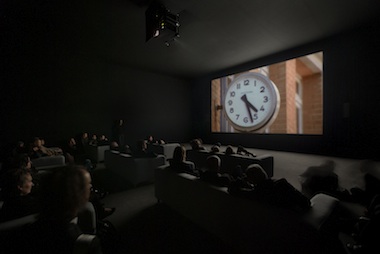
Christian Marclay. The Clock, 2010; installation view, White Cube Mason’s Yard, London, October 15–November 13, 2010; single-channel video with sound; 24:00:00. Courtesy of the Artist, Paula Cooper Gallery, New York, and White Cube, London. Photo: Todd-White Photography. © Christian Marclay.
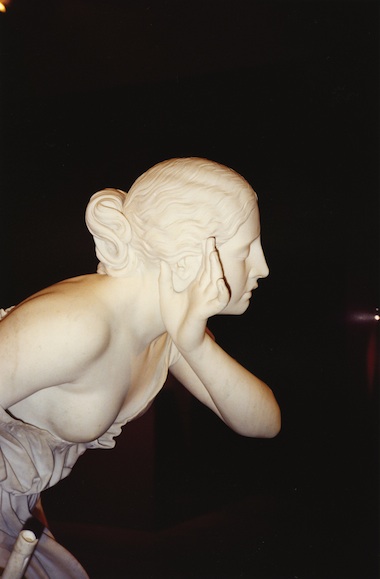
Christian Marclay. Boston, 2000; chromogenic print; signed, titled, dated, and numbered verso in ink; image: 11 x 7.38 in. Courtesy of the Artist and Fraenkel Gallery, San Francisco.
Spend more time with the photos, however, and worlds begin to open up—never within the photographs, which maintain a rather hilariously narrow and deadpan focus, but somewhere just beyond them. Waiting communication channels (payphones on and off the hook; speakers of door buzzer systems) and cryptic clues (an unidentified instrument inside an enormous canvas bag, lugged by mostly-unseen transporters; a curious, wall-mounted button labelled "musique," under the thumb of a mischievous-looking, bespectacled old man) draw the inquisitive viewer’s imagination toward countless unseen worlds and untold narratives. Marclay himself articulates the guiding attitude: “Now, every day seems to be a stage in an endless journey. I feel the need to take photos during these journeys, positioning myself not as a tourist but more as a scientist seeking out rare specimens, or like a detective hunting for clues.”1
By and large, Marclay’s oeuvre is marked by a penchant for creative destruction. He has broken and re-assembled vinyl records (Recycled Records, 1980–86), torn up photographs (Fourth of July, 2010), videotaped the death rattle of a Fender Stratocaster dragged along a dirt road by a truck (Guitar Drag, 2001), unfurled and flung the magnetic tape from music cassettes to make Pollock-esque photograms (Cyanotypes, 2008), and, of course, fragmented and sutured countless film narratives to make The Clock. Things I’ve Heard is interesting for the very reason that, being a straightforward collection of photos, it is in no way destructive. More than being constructive, though, it is rather suggestive, operating on a simple ontological principal of photography articulated by Jean-Pierre Criqui in his essay on Fourth of July:
A photograph can exist only on the condition that it separate itself from an out-of-frame space which it simultaneously cancels and evokes. These fragments emphasize the fact: a photograph hides as much as—if not, strictly speaking, more than—it shows.2
The same principle half applies to film, where in one sense the real world keeps going beyond the camera’s lens but in another sense the fabricated world of the story does not; it ends where the set does. This brings us back, finally, to The Clock, which, in its dense sequence of partial narratives and moods, continually radiates our attention beyond the frame toward worlds both fictional and real: those of the beloved characters, yes, but also that of the actors, of Hollywood, of society, at various points in time—a poignant memento mori. In this sense, The Clock is quite similar to the carefully sequenced photos in Things I’ve Heard, which likewise gather around a common thematic thread but each obliquely suggesting a world and story unseen.
The value of these collections is not in their size, explicit visual content, or material method of production but rather in their attitude toward the images involved. Behind these photographs and the clips in The Clock is not a tourist of music or film culture but rather “a scientist seeking out rare specimens, or a detective hunting for clues.” What separates the scientist and detective from the tourist goes beyond activity and passivity, centering instead on the intentions in looking. Tourists set out to see things themselves; scientists and detectives look at things because of how they point to something else and perhaps to nothingness, both invoking and cancelling what lies beyond the frame.
The Clock is currently on view at the San Francisco Museum of Modern Art through June 2, 2013, and Things I’ve Heard is on view at Fraenkel Gallery, San Francisco, through May 25, 2013.
________
NOTES:
1. Christian Marclay, “A Conversation with Christian Marclay,” Christian Marclay: Things I’ve Heard (San Francisco and New York: Fraenkel Gallery and Paula Cooper Gallery, 2013).
2. Jean-Pierre Criqui, “Image on the Run,” Christian Marclay: Fourth of July (New York: Paula Cooper Gallery, 2010).