
Shotgun Review
The Candy Store
June 16, 2010If we regard laughter as a kind of expulsion, even a kind of vomiting, then “The Candy Store,” at Meridian Gallery, is a mess. It’s sticky, sweet, and smelly. It’s cute and at the same time grotesque. Of the many treats on display, one particularly beautiful mess is John deFazio’s The Budweiser Power Urn (1997). Elaborately decorated with wallpaper-like leafy prints, a tattooed, bug-eyed skull, and a Budweiser bottle label, this urn mixes the slapstick punch of a Kippenberger with the earnestness of a prayer. In restless play with deFazio’s other urns and sculptures, this piece succeeds in bypassing laughter as an end in itself and instead employs it as a means toward a meditative state.
Not far from this state stands Leigha Mason’s installation and performance space, Candy Store (2009–2010). Adorned with broken jars, caramel- and fecal-colored candy stands, and three oversize artificial peppermints, the store displays chimeric candy. Translucent lollipops contain candy bits and human body parts: hair, fingernails, teeth, skin, and eyes. At once attractive and repulsive, Mason’s treats tease the viewer into a state of anxiety and desire over both the (un)appetizing object and a viewer’s place before it. If a viewer laughs, her laughter might be nervous, while still allowing the possibility of meditation. If a punch line exists, it lingers just out of view.
Upstairs, the colors start to fade. DeFazio’s black-and-white Porno Garden of Earthly Delights (2000) collages cartoon porn and caricatures atop a Xerox tapestry of Bosch’s famous triptych. Appropriating only the center panel of Bosch’s original, the piece levels narrative into a singular state of play. Behind Porno Garden, Mason’s Bacilli (2010) series establishes a possible mirror with Candy Store.
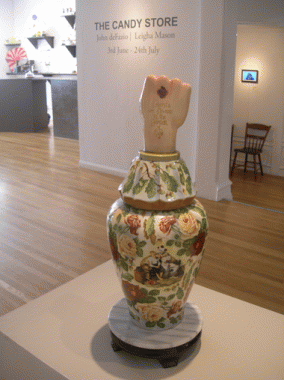
John deFazio. The Budweiser Power Urn, 1997; porcelain, 19 x 7 x 10 in. Courtesy of the Artist and Meridian Gallery, San Francisco.
In eleven graphite drawings, Mason depicts aged and diseased children enjoying clean candy, cake, and gifts. Inverting the dynamics of her Candy Store, these drawings quietly and sometimes not so quietly (the kids will laugh and point) beg the question: how does the viewer appear in this mirror?
If there is any end to the baroque mess of “The Candy Store,” perhaps it rests somewhere in deFazio’s 100-panel Xerox journey, The Divine Comedies (1990–1992). Snaking around the third-floor gallery, the sequence dances between laughter as scream and collage as soulful exploration. Here lies most explicitly the meditative and, ultimately, transformative potential made possible by “The Candy Store.”
“The Candy Store” is on view at Meridian Gallery in San Francisco through July 24, 2010.
Tom Comitta is a writer and editor (of Shiterature) whose work has appeared in elimae, Try, New American Writing and is forthcoming in VOLT.