Review
The Inward Turn
December 1, 2015On View
Jessica Silverman Gallery
November 6 - December 19, 2015 Solo ShowImagine departing on a journey in which your destination is simply a return to the same place of origin. Upon your return, you find yourself unchanged. Intact. Undigested. Whole. And exactly where you started. The Inward Turn, Julian Hoeber’s solo exhibition at Jessica Silverman Gallery, offers such a proposal.
In all of its twists and turns and deviations, the exhibition’s paintings, sculptures, and works on paper always turn the viewer inward. And yet, in this closed, infinite system, there is more to ponder than the paradoxical experience of such a visual journey. The texture, imperfections, and meandering tangents of the system itself offer reprieve from the loop, and a space to meditate upon the causal binary relationships of loop and looped, of mold and cast, and of viewer and visual artifact.
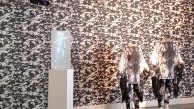
The exhibition’s methodology of call and answer is powerful. The conversation opens with Brutalized Organs (2015), which commands attention from the back of the gallery. The sculpture is a stacked pair of double-ended pink funnels made of fiberglass and cement that rest upon a glass-top table. Like massive, hollow rungs of a precariously organic ladder, the form walks the conversational line between the strength of architectural structure and the suggestive permeability of an opening orifice. The surface texture of the piece reveals thin, unraveling fibers embedded in a matrix of an all-too-familiar texture pocked with air bubbles and inconsistent pink pigment. This could be skin, and yet the geometric staccato of the castings’ mold denies that assertion.
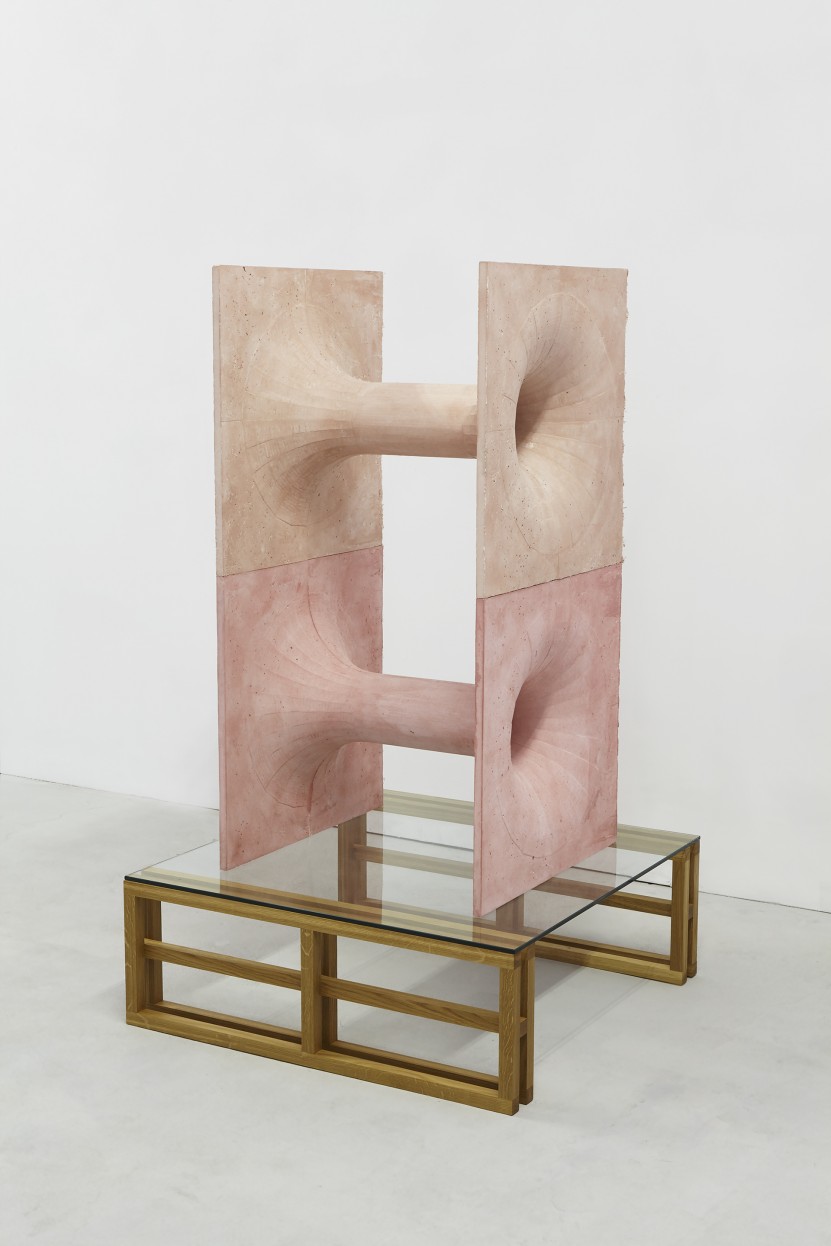 Julian Hoeber. Brutalist Organs, 2015; sculpture: pigmented fiberglass reinforced with ultracal cement; pedestal: oak with catalyzed finish and glass; two-part sculpture: 24 x 24 x 24 in.; pedestal: 12 3/8 x 35 x 25 in. Courtesy of the Artist and Jessica Silverman Gallery, San Francisco.
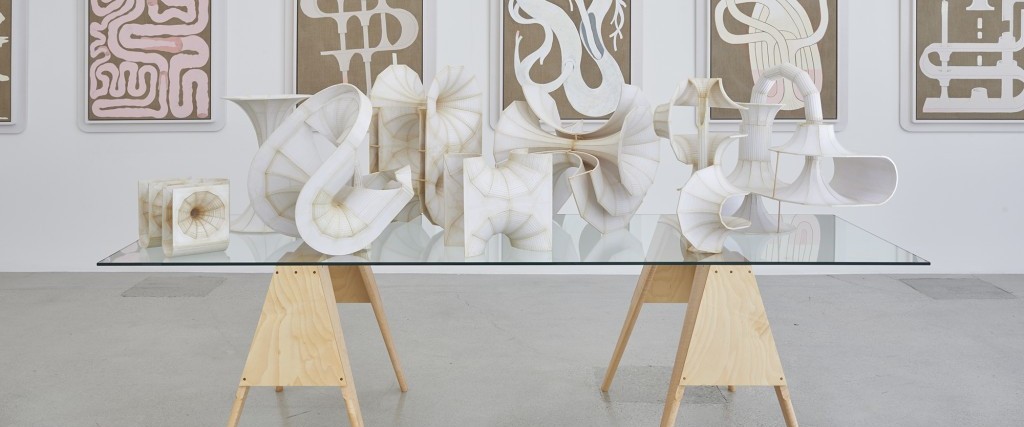
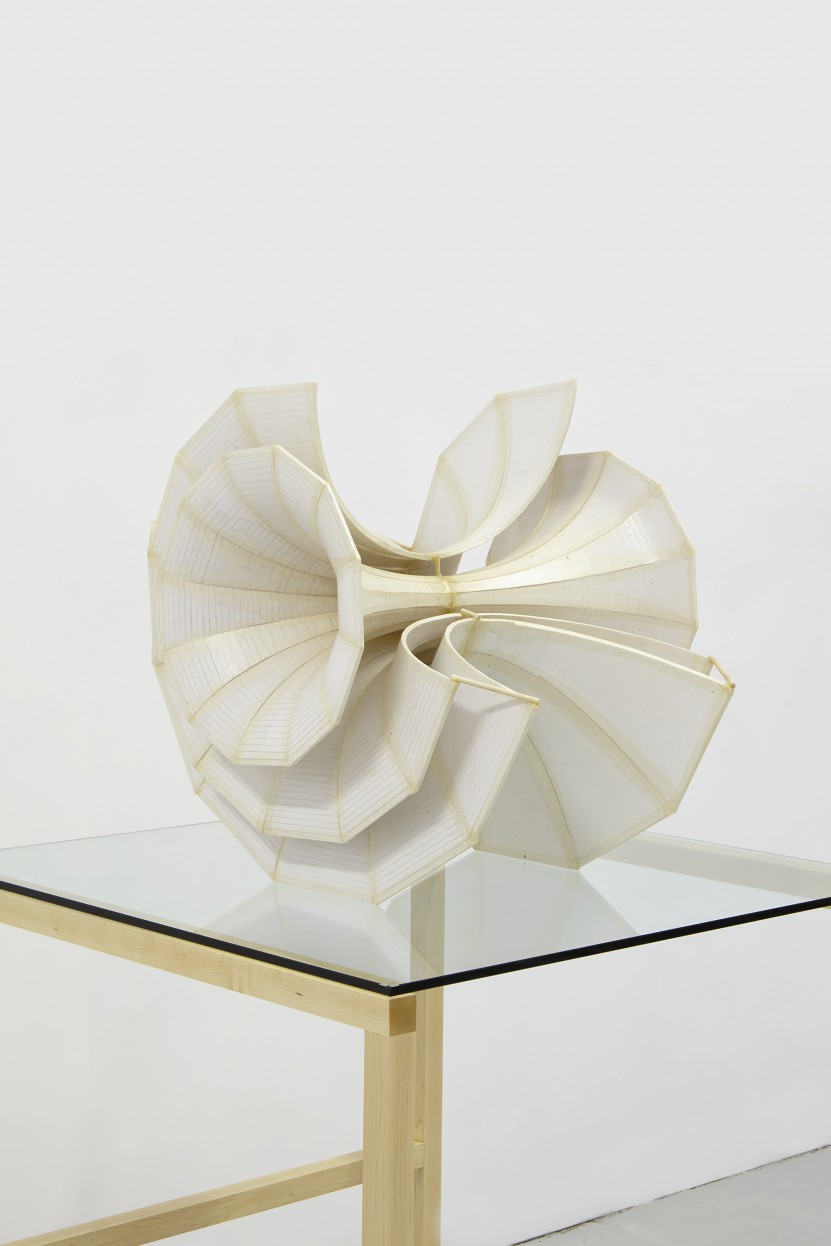 Julian Hoeber. Thought of Forms/Form of Thoughts 05, 2015: foamcore, kozo, dowels, and shellac; 21 x 25 1/2 x 19 in. Courtesy of the Artist and Jessica Silverman Gallery, San Francisco.
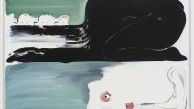
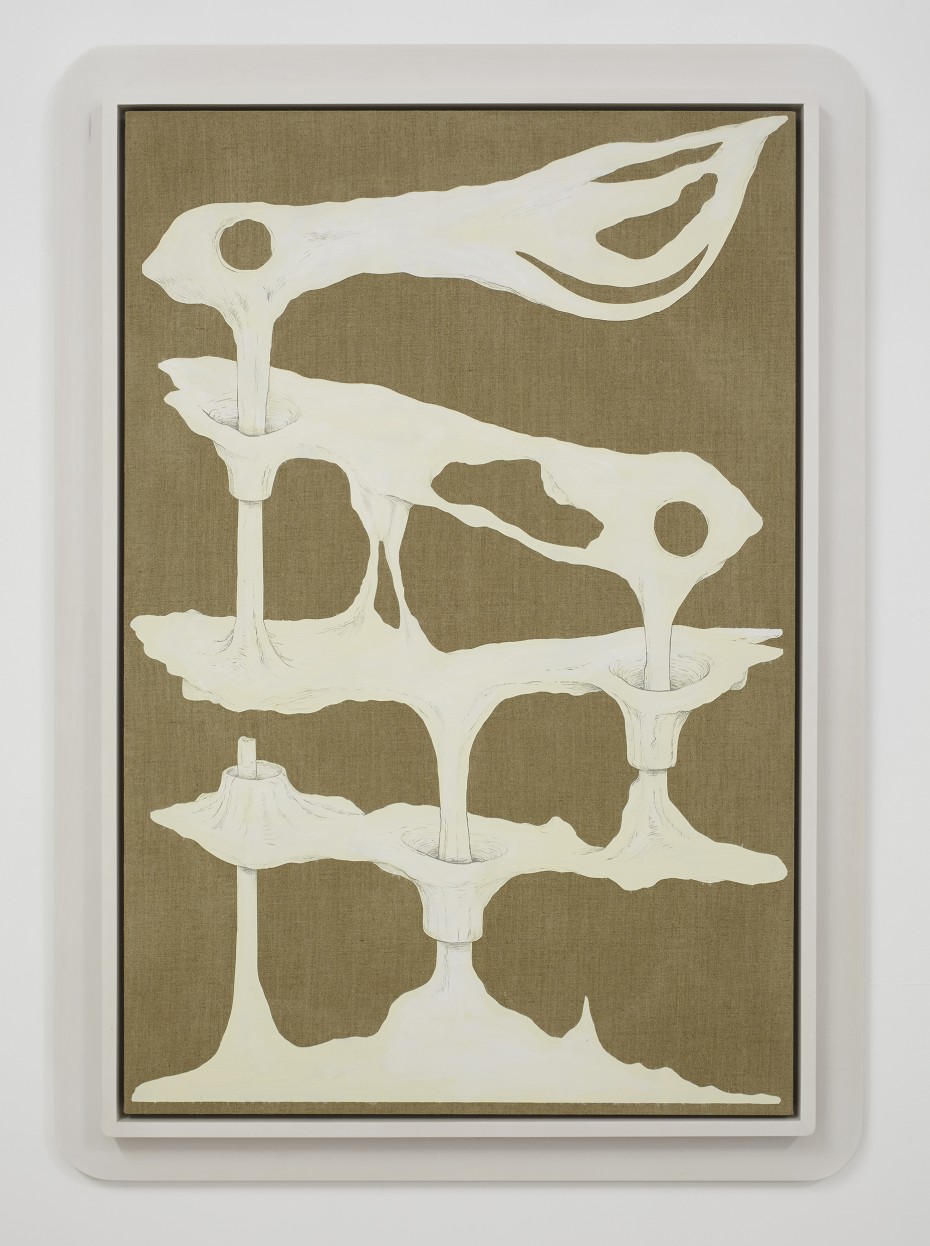 Julian Hoeber. Ruminating Elevation, 2015: Flashe and acrylic on linen with artist’s frame; 48 1/2 x 34 1/2. Courtesy of the Artist and Jessica Silverman Gallery, San Francisco.
A similar tension is proposed in Thought of Forms/Form of Thoughts 05 (2015). This piece’s delicate structure consists of thin strips of white foamcore shellacked into outward-reaching conical plumes. These repeated forms intertwine and stack to capture the negative space between them. This is a study for a mold that would create a very specific positive cast. And as such, the piece confidently nods back toward Brutalized Organs—while not one-to-one mates, they are certainly kin, and they both know it.
Thought of Forms/Form of Thoughts 05, however, is more than just a simple study of a process-based technique. A cross-sectional opening reveals the piece’s inner workings and allows for a deeper meditation on its negative space. The opening draws the viewer closer into the cavern only to abruptly halt the journey with the complex surface texture of the piece. Upon close inspection, it becomes evident that translucent, yellowing, water-stained rice paper is the only support that holds together these undulating forms. Its matte texture is bubbled, creased, and rippled in places where gravity is fighting the structures’ delicate joints. A crack here, a mismatched angle there reveal slices of light through the thin skin. Such imperfections emphasize that these are not functional molds, but rather paraphrased thoughts of a much larger dialogue; the inward-facing infinite is a conceptual meditation on negative space, and these delicate structures are a fleeting, failing attempt to capture it.
Lining the walls of the gallery, the surreal architecture of Hoeber’s paintings offers a conceptual meditation on the infinite that is unbound by the physics that governs three-dimensional work. This flatwork, however, comes with its own arbitrary rules. In each piece, the images sit comfortably within the border of the canvas, careful not to touch or acknowledge the edges, and this strategy generates its own kind of curiously looping relationship between the mold and the cast.
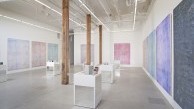
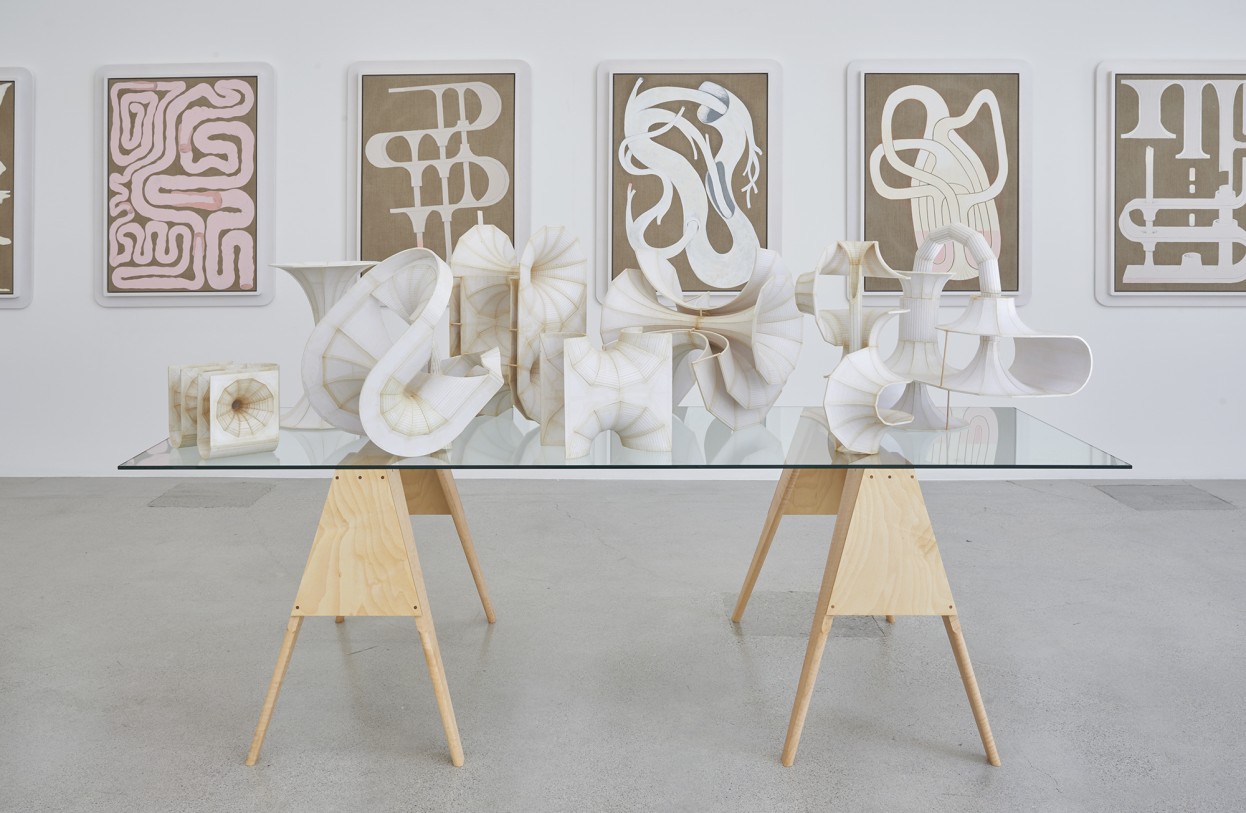 Julian Hoeber. The Inward Turn; installation view. Courtesy of the Artist and Jessica Silverman Gallery, San Francisco.
The eight paintings that serve as the backdrop for the Thought of Forms/Form of Thoughts series take the idea of this bounded relationship one step further. Each of these paintings on unprimed linen are of the same dimensions, and sit in white rounded-edged frames that both bridges and others the relationship between the neutrality of the gallery wall and the bold, milky images on the burlap-colored background. The presentation is strange, visually startling, and smart.
One of these paintings, Ruminating Elevation (2015), is a Flashe and acrylic painting of an interconnected, chalky, bone-like structure. The central milky form is bold and unmodulated, detailed only by thin, illustrative gray line work around its edges, occasionally emphasizing spatial distance. The sinewy shape zigzags downward in a slow rhythm that leads the eye painstakingly through a grotesque voyage to the bottom—only to be asked to return upward yet again. This work is strikingly different from the other looping propositions of this exhibition. Here, the viewer takes an organic visual journey through skeletal stalactites and stalagmites that do not always connect, and those gaps are bold and abrupt.
The Inward Turn is a thorough exploration of the surface and contained space of the infinite, and contrary to the title’s proposal, evokes a meditation that does more than simply return one to the place of origin.
________
This article is made possible through our Writers Fund, thanks to readers like you. Help us keep it going!
Julian Hoeber: The Inward Turn is on view at Jessica Silverman Gallery, in
San Francisco
, through December 19, 2015.