
Shotgun Review
From Beijing: On/Off: China’s Young Artists in Concept and Practice
April 8, 2013On/Off at Beijing’s Ullens Center for Contemporary Art displays fifty new works by artists born after 1975, the generation that followed the Cultural Revolution and emerged during China’s period of rapid economic growth. The curators, Bao Dong and Sun Dongdong, chose the show’s title to reflect the online proxy networks that younger Chinese use to circumvent the government’s firewall. Bao and Sun compare the networks’ on/off extremes to the contradictory conditions in which young Chinese artists generate work. The show provides an overview of those conditions and spans multiple mediums, including performance, film, sculpture, and painting. However, On/Off lacks curatorial direction and reflects less of how young artists create and more of the problems with the art market that demands quantity over quality.
This lack of curatorial finesse results from an economy in which the Chinese are expected to make products legible to outside audiences. For example, the Western media has extensively covered Li Liao’s performance piece Consumption (2012).1 Li worked at Foxconn, where Apple’s iPad is manufactured. After earning enough to purchase the product, Li left the factory. As an artist, he has the privilege of displaying the iPad along with his contract and uniform in the exhibition rather than remaining in poor working conditions. Although Li’s performance is conceptually rich and reaches beyond capital and into the realm of the ethics of art, the outside attention on Consumption primarily discusses it in relation to China’s development and capitalism.
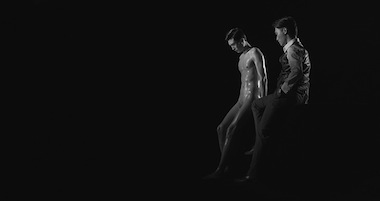
Yan Xing. Arty, Super-Arty, 2013 (film still); single-channel high-definition video, 9:16. Courtesy of Galerie Urs Meile, Beijing-Lucerne.
That said, many of the video works offer refreshing explorations that aren’t overdetermined by this dynamic. I was deeply moved by Yan Xing’s Arty, Super-Arty (2013), a nine-minute black-and-white video that reimagines Edward Hopper’s Nighthawks through characters and objects in Yan’s life. The work is deceptively simple; Yan films bodies inhabiting various tableaux. As the film develops, though, the mere act of breathing and the connection between bodies produce a tension that forced me to watch for over an hour. Yan captures and displays those states between language and feelings, such as the anxieties and exasperation experienced between lovers ending a relationship.
The curators’ focus on the binary of on/off is misguided. Perhaps the idea of a proxy network itself, as it connects users through a different location to engage with the world, is more appropriate to framing and curating the work of younger artists. This generation relates and expands its work in ways that are not always legible to outside audiences; nonetheless, this could be a way to think more deeply about it beyond on or off: they’re between and beyond.
On/Off is on view at the Ullens Center for Contemporary Art, in Beijing, China, through April 14, 2013.
Hentyle Yapp is a PhD candidate in performance studies at UC Berkeley, writing on contemporary Chinese performance art as it circulates the global art market. Yapp danced professionally for companies in Taipei and New York City and received his BA from Brown University and JD from UCLA. Yapp is a finalist for the ACAC Writing Fellowship.
________
NOTES:
1. The New Yorker featured a long interview with Li, http://www.newyorker.com/online/blogs/evanosnos/2013/01/what-is-an-ipad-doing-on-a-pedestal-at-a-chinese-art-museum.html. In addition, the Los Angeles Review of Books, Artforum, and various blogs focused on Consumption