
1.4 / Review
Living Room
December 2, 2009What happens when one becomes acutely aware of the divide between the self and the world? How do the spaces we inhabit help us cope with this divide and ultimately define our existence?
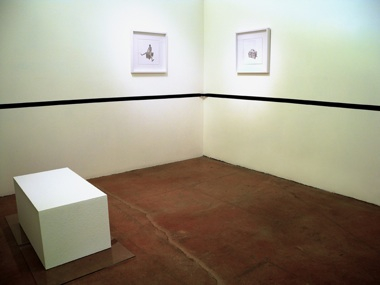 Jordan Essoe, Living Room, 2009; installation view, Swarm Gallery. Courtesy of the Artist and Swarm Gallery, Oakland.
Both rooms are effective in drawing attention to their given materials and I find it rewarding to meditate on the textures that Essoe has made into objects of beauty. In the second, the floor sculpture Rock (2009) echoes the chest depicted in the finely rendered drawings—different perspectives of Essoe straddling the box. The sculpture’s placement opposite the drawings suggests seating for a guest. The photographs in the first room are beautiful black and white close-ups of the artist’s carpet and ceiling fan. Shadow lines play as motifs throughout, both in situ on the wall as part of the installation, and as depicted in the images. The video on the floor shows a performance (an exercise in Sisyphean absurdity) in which the artist unhurriedly vacuums a grassy hillside, which the viewer sees through the imprisoning grid overlay of a wire fence, further dividing the screen into squares of grass, nearly indistinguishable from the film’s static.
Of the media listed above, I have left for last mention the segments of shiny black tape, which Essoe placed on the walls at a three-foot height, like a horizon line. The tape encircles the walls of the second room, but is interrupted by a small square wall drawing the exact height of the tape that depicts the bumpy relief of the wall on which it is drawn. This drawing is placed just above Rock and I notice how the bumpy surface of the drawing imitates that of the sculpture.
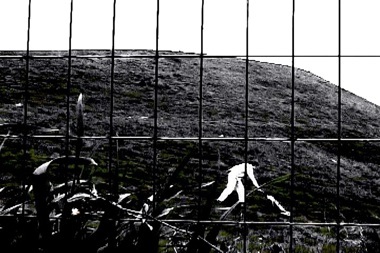 Jordan Essoe, The Myth of Sisyphus, 2008 (still); digital video; 50:48, loop. Courtesy of the Artist and Swarm Gallery, Oakland.
If given the choice to spend a lengthy, undetermined amount of time in either room, I would choose the second. Here, the concepts Essoe explores through his selected media remind me how the poet Max Jacob defined artistic activity, as “the effect of a thinking activity on an activity that has been thought.”2 Contemplating each object’s materiality and their interdependence brings me to a kind of double consciousness and shock of recognition. I further recall Jacob’s words about a work offering “the sensation of being self-enclosed.”3 I experience this sensation as I notice the shiny black tape both calling attention to itself and unifying this drawing on the wall with the wall itself. The chest in the drawings and the similarly shaped sculpture on the floor (whose surface resembles the wall’s) comment on each other. I feel like an art object contemplating its own existence within the constraints it has been handed.
There are both subtle and obvious references to existentialist philosophy throughout the installation, such as the Sisyphean performance, but the nuances of meaning that Essoe frames are not necessarily apparent. I find, however, I do not need to wrap a tight ribbon around the boxes, both literal and figurative, that he has presented. As Living Room demonstrates, the closer one looks, the more one is rewarded.
Living Room in on view in the Swarm Gallery Project Space through December 6, 2009.