Review
Living Digital Space and Future Parks
March 15, 2016On View
Pace Art + Technology
February 6 - July 1, 2016 Group ShowWhen Toshiyuki Inoko decided to leave the countryside for the university in the mid ’90s, the internet was still growing, but he was already imagining that “the networks and digital fields would become big and create new societies.”1 Today, Inoko is the founder of the Japanese collective teamLab, which was founded in 2001 to organize artists, programmers, computer-graphics animators, and others to create spaces that live up to the vision he had in his youth. TeamLab's 20,000-square-foot exhibition, Living Digital Space and Future Parks, is the first show at Pace Art + Technology in Menlo Park, adding to the Pace organization’s global presence of galleries in New York, London, Beijing, and Hong Kong. Living Digital Space and Future Parks quickly extracts you from reality and brings you into a world where you feel the heartbeat of technology pulsing in everything.
You enter this world through the first of two buildings, which is devoted to large, enveloping installations that often utilize high-definition projectors and monitors to play visually stunning animations. TeamLab recalls and then destabilizes the traditional Japanese aesthetic of flatness to create what they call Ultra Subjective Space. The imagery in Ultra Subjective Space is not contained by optical perspective. Its subjectivity lies in the visual aspects, but its spatial effects are visceral. The installations in the exhibition insert visitors into the artworks as central subjects whose actions directly create an infinite number of outcomes and vantage points.
There is little time to adjust to what you are about to experience once you pass through the initial curtain dividing Pace's lobby and teamLab's exhibition. The lobby's bright windows are gone, and you are left in a large, dark room with tall ceilings. The only light in the room comes from a massive LED cube that hangs in its center. Inside the cube, thousands of lights flicker and change colors to simulate three-dimensional flames. The piece, appropriately titled Light Sculpture of Flames (2016), is programmed to evolve in real time—never creating the same pattern twice—and does so as rolling ambient tones undulate and crescendo according to how visitors move throughout and populate the room.
 teamLab. Flower and Corpse Glitch Set of 12, 2012; digital work; 12 channels. Courtesy of the Artist and Pace Art + Technology.
Another example of the exhibition's dynamism is found in the series Flower and Corpse Glitch Set of 12 (2012). These animations were first created using three-dimensional graphics software, and were then converted to flat, two-dimensional video. Across the twelve vibrant displays, stories unfold about a thriving Japanese city and a dragon spirit. The civilization becomes invasive in its expansion, and the forces of nature, including the dragon, push back. The animations progress slowly, but are continually opening up as clouds part over villages, whose buildings slowly crumble to reveal a digitized infrastructure behind it all. As your eyes move across the individual screens, new objects and ways of connecting the narrative continue to present themselves. The hybrid of the two- and three-dimensional software makes the scenes feel expansive and the characters very alive, but all with the feeling of a pop-up book whose flat figures stand on a three-dimensional plane.
The second building of installations are purportedly designed specifically for children, but were nonetheless fascinating to myriad visitors. People of all ages knelt down at small tables with crayons to color in templates given out at the entrance, which were quickly scanned in a matter of seconds and dropped before the viewers’ eyes to form the projection of a bustling cityscape on a long wall. The resulting metropolis, populated by everyone's drawings, became a living collaboration, with participants repeatedly coloring in templates as they discovered more ways to alter the world in front of them. As the exhibition title suggests, teamLab sees these computerized “future parks” as potential sites for all to imagine and create unbounded. Together with the other works in the show, the exhibition makes for a very accessible experience for families.
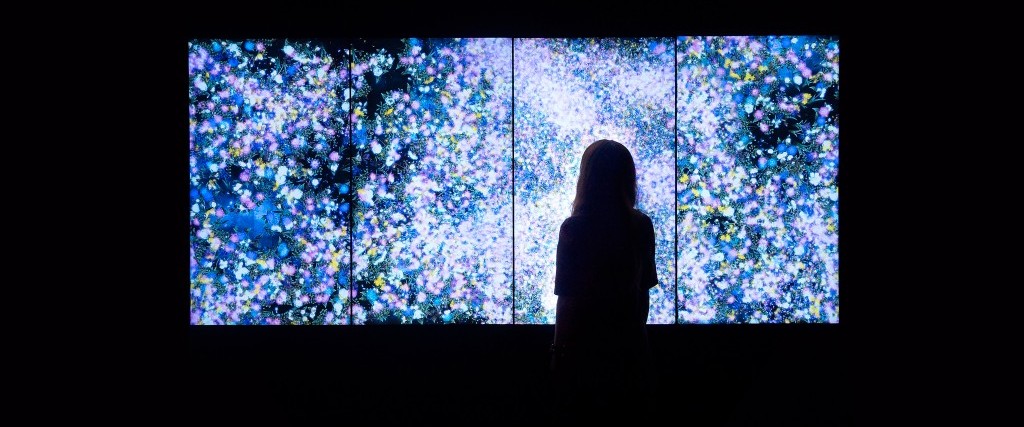
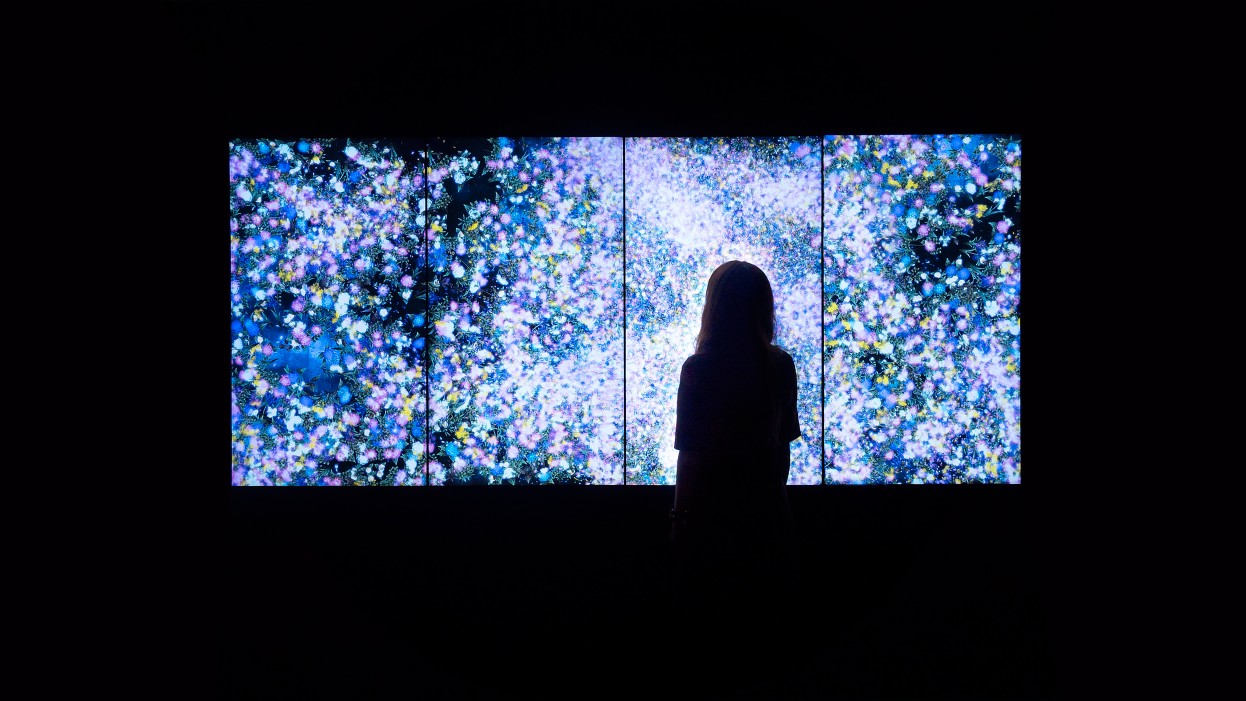 teamLab. Flowers and People – Dark, 2016; interactive light sculpture; 4 channels. Courtesy of the Artist and Pace Art + Technology.
 teamLab. Flower and Corpse Glitch Set of 12, 2012; digital Work; 12 channels. Courtesy of the Artist and Pace Art + Technology.
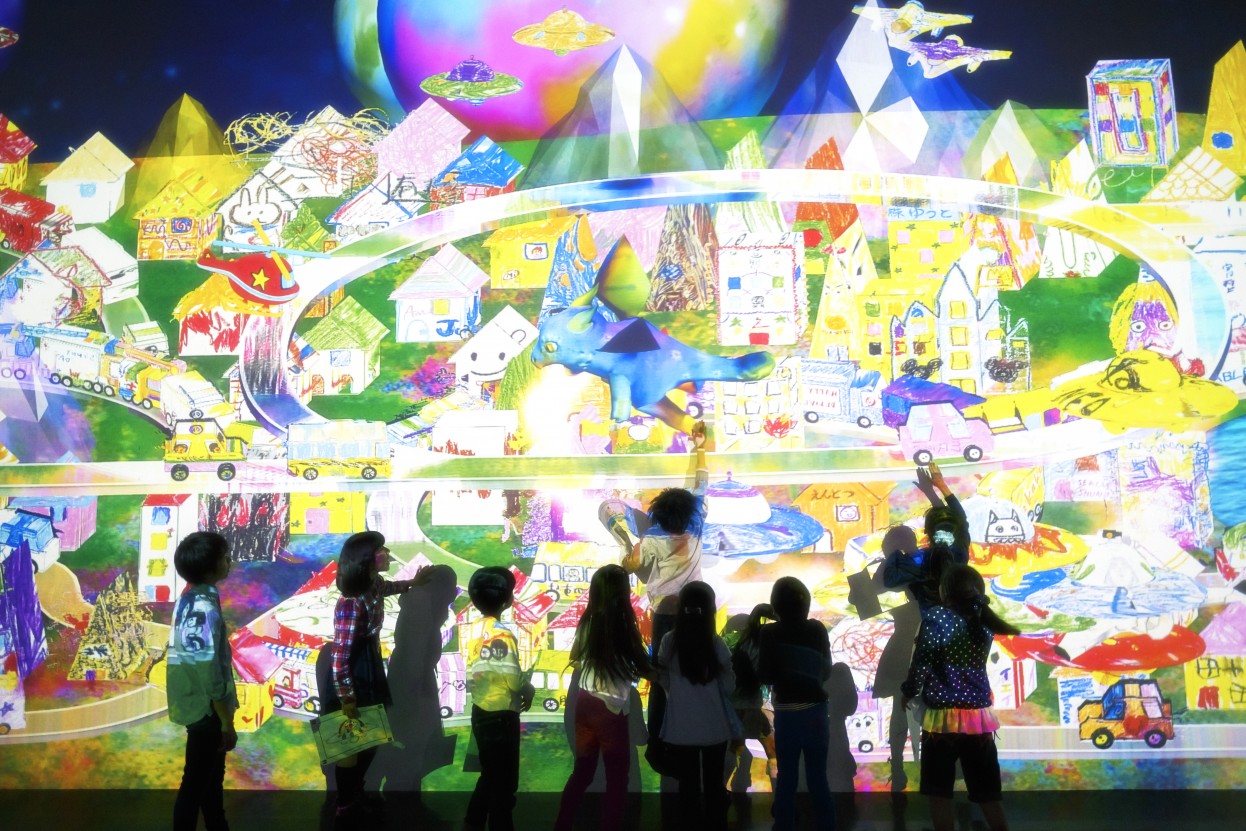 teamLab. Sketch Town, 2014; interactive digital installation. Courtesy of the Artist and Pace Art + Technology.
Every time a curtain is pulled back in this exhibition, visitors are pulled into something unexpected and alive, demanding sensory palates to restart and rebuild relationships in each room. The level of engagement necessary for this process is exhausting, but at the same time leaves senses warmed and amplified. Reentering the world of Menlo Park after visiting Living Digital Space and Future Parks is like climbing out of a cave that you just discovered hidden treasure in; you’ve lost track of time, everything is incredibly loud, and you’re desperate to go back in because you took only what you could carry. In our day-to-day lives, technology has become nearly essential as we've developed dependencies on smartphones and online communities, but rarely does technology’s presence feel like a warm embrace. Often, it can feel like technology surrounds us with only commercial intent, preying on our every move, and always convincing us to consume more. This show is incredibly optimistic because it displays not only the power of technology as an artistic medium, but also its potential to symbiotically construct spaces that are animated and yet open-ended.
The opening of Pace Art + Technology comes after Pace used the space for pop exhibitions over the past two years, presumably testing the waters of receptivity in Silicon Valley (prior to that, the space was a headquarters for Tesla Motors). In April, Pace will unlock another Bay Area location in nearby Palo Alto, opening with a show of new light works by James Turrell. Perhaps Pace has merely identified a profitable niche for art and technology in Silicon Valley, but regardless, the planting of their flag is a symbol of an expanding art community in the Bay Area. While it represents a global perspective more than a local one, an organization like Pace setting up shop here sends a message that something unique and exciting is happening.
________
This article is made possible through our Writers Fund, thanks to readers like you. Help us keep it going!
Living Digital Space and Future Parks is on view at Pace Art + Technology, in Menlo Park, through July 1, 2016.