
Shotgun Review
John Cage
March 13, 2012John Cage once told the philosopher and poet Joan Retallack that his system of indeterminacy—often misunderstood as a complete abdication of control—shifted the province of intention “from the responsibility to choose…to the responsibility to ask.”1 Cage’s questions bounded his work, determining, for example, the range of colors, lines, or images from which his chance operations would “choose.” This approach limited but did not eliminate the intrusion of intention in his artistic process. It complicated and reframed the idea of artistic agency, long before appropriation artists were cutting and pasting. At Crown Point Press, on the occasion of the one hundredth anniversary of Cage’s birth, visitors can view a selection of the visual work Cage produced with the help of the press’s founder and pioneering printer, Kathan Brown.
Despite Cage’s process, nothing in the appearance of his work suggests a silencing of intention. In Without Horizon #33 (1992), a meandering brush line evokes a hill. An object in front of the line evokes seaweed or a beached sea animal. A smudge above the line resembles a hazy sun. Without Horizon #33 seems deliberately representational, but the placement of every mark is the result of a chance operation.
Cage was deeply influenced by Zen Buddhism’s “whispered truths,” especially “Make no impression.” He touches a paradox within this statement, revealing how the almost impressionless (and intentionless) registers deeply in a viewer even twenty-five years after a work’s making. At one moment, Eninka #28 (1986), for which Cage both smoked and branded the paper, appears gentle and suggests a leaf seen from above, falling to the ground. At another moment, it appears violent: a current, a vortex, an abyss. Cage told Retallack that Mark Tobey's painting, Untitled (1961), was his "guiding star," exclaiming: “What’s so beautiful is that there’s no gesture in it.” In Eninka #28, Cage’s process results in a product that is perhaps not gestureless but defiant of the stability of any single gesture.
Where R=Ryoanji: R3 (1983) is, at first, anything but ethereal or gestureless. The page, covered by the outlines of fifteen stones drawn 3,375 times (or 153), is concrete, resolute.
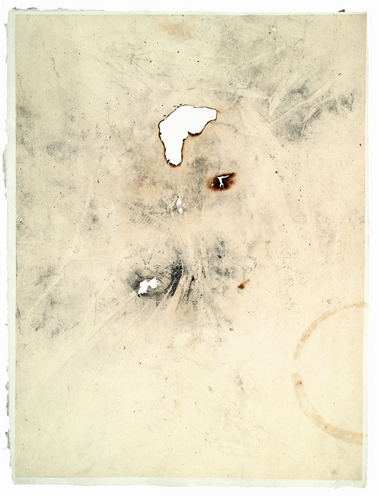
John Cage, Eninka 28, 1986; one in a series of fifty smoked and branded prints on gampi paper chine colle; 25 x 19 in; published by Crown Point Press, San Francisco. Courtesy of Crown Point Press.
Yet even in a piece so worked by Cage’s hand, the gestures seem gestureless, defying the very mark of his insistent mark-making. The work does not fade into a mass of grayness but resolves instead into an intricate web, a forest of chance encounters.
Cage’s retreat from intention and his predilection toward the gestureless underpin the work at Crown Point. It would be a mistake, however, to conceive of the results as illustrations of a theory. Cage was delighted when he found beauty in the works he made, and an unexpected beauty is, indeed, the lasting impression of the exhibit.
JOHN CAGE IS ON VIEW AT THE CROWN POINT PRESS GALLERY, IN SAN FRANCISCO, THROUGH MARCH 31, 2012.
Rob Marks has an MA in Visual and Critical Studies from the California College of Arts and writes for DailyServing. He is also the Publications and Training Manager for the UCSF Alliance Health Project.
________
NOTES:
1. All quotations from Joan Retallack, ed., Musicage: Cage Muses on Words, Art, Music (Hanover, NH: Wesleyan University Press and University Press of New England, 1996).