
1.1 / Review
Hot & Cold: The End is Here
October 29, 2009The zine—originally intended to cheaply disseminate ideas and images amongst groups of artists, writers, and activists—has been largely displaced in recent years by the relative ease of the Internet. What has been lost in this transition from manual to digital is twofold. Like the record supplanted by the CD and later the mp3, the replacement of zines with blogs and other digital platforms has diminished the objecthood and handmade artistry that we covet in the enjoyment and collection of these things. Also gone missing from the more solitary endeavor of blogging is the sociability of zine release events, bookstore gatherings, and hand-to-hand distribution. Enter Hot & Cold.
Co-creators Chris Duncan and Griffin McPartland have refused to give up on this medium even when other zine collectives and shops have disbanded. Duncan told me when they started the Hot & Cold project seven years ago, “usually zines go downhill the longer they are produced, so we plan to do the opposite by starting with issue ten and just get better and better as we count down to one.” That day has arrived. Issue #1 (along with Issue #0) is, as promised, their most ambitious project to date, its launch coinciding with an equally inspiring show at Baer Ridgway Exhibitions.
The exhibition poster signified Hot & Cold‘s finale: Duncan and McPartland walk the streets of downtown San Francisco holding protest signs that declare “The End is Here.” The poster echoed many of the more political artworks in the show. Michael Arcega’s A Window into the Apocalisp, Ryan Wallace’s A Brief History of Demise, Reed Anderson’s Hill of Debt, Mountain of Greed and Mads Lynnerup Untitled Green spoke to the growing economic concerns of our generation as we have witnessed great heights of excess and recession. As a counterpoint, many of the works in the show took a more personal and hopeful view. Jay Nelson’s Good-Bye Ranch was an intensely detailed drawing that depicts his muse Carol—aka the patron saint of Ocean Beach—who created the first halfway house in the ‘60s. Michelle Blade’s watercolor homage to poet Ranier Maria Rilke offered inspiration to look inward and keep creating, even through hard times.
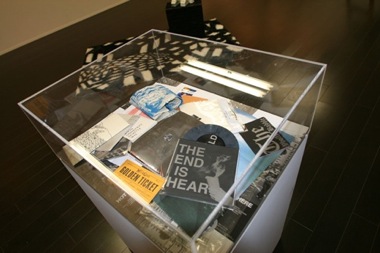
Chris Duncan & Griffin McPartland. Hot & Cold Issue #1, 2009; mixed media.
As Rilke states in letter #10, “Art too is just a way of living…” and the final Hot & Cold project took this idea to heart. My experience viewing the show was complimented by a performance by local band Coconut with frontman/drummer Colter Jacobsen positioned next to the Rilke bookcover (a nice accident?). Taking my copy of Issue #1 home, I popped in the 7’’ record featuring tracks by Soft Circle, the Urxed, Tommy Guererro, and Namesake and was transported while leafing through 170 handcrafted pages and silkcreened envelopes full of surprises: everything from bandanas and stickers to mini-zines. The collision of live and recorded music, handworked images and limited edition objects felt more like a kit for living than an art publication.
The inserted map by David Wilson led the Hot & Cold viewer out of the gallery space and on another journey. Wilson’s events—produced under the name Ribbons —celebrate the intersection of music, social gatherings, “land art,” and food. After scouting out a well-hidden grove in the Richmond hills, Wilson and conspirators constructed a massive “Memorial Fort” out of native twigs and brush. Swings, ditches and mild interventions were inserted into the landscape where the public was invited to play, potluck, and enjoy live music last Sunday.
“Memorial Fort” video courtesy of Adam Cimino
At the end of the day, Hot & Cold is about creating a new community of makers; new in the sense that the highlighted artists do not share a common locale or genre but a like-mindedness—an inclination towards fusing their art practice with a whole lifestyle perhaps—and at most, two degrees of separation. With the art world rapidly globalizing, far-flung artists are able to form bonds and influence one another through various webs of interaction, including the Internet, art fairs and roving art shows. I thank Hot & Cold for seven years of keeping these points of connection authentic and varied.
"Hot & Cold: The End is Here" was on view at Baer Ridgway Exhibitions in San Francisco through October 17, 2009.
Dina Pugh is Co-Director of Triple Base Gallery, San Francisco, as well as an independent curator and writer who has organized exhibitions in San Francisco, Tokyo, Los Angeles and New York. She received her BA from Stanford University in 2000 and her Masters in Curatorial Practice from California College of the Arts in 2006.