
Shotgun Review
From Los Angeles: Selections from Pacific Standard Time
November 1, 2011Pacific Standard Time (PST) unites over sixty venues throughout Southern California to address the art scene that emerged there between 1945 and 1980. Edward Kienholz: Five Car Stud 1969–1972, Revisited, at the Los Angeles County Museum of Art (LACMA), is the first U.S. public exhibition of Edward Keinholz’s electrifying Five Car Stud (1969–72/2011), which, for me, is the work that conveys the same raw power it did in its initial presentation in Germany nearly forty years ago. Viewers walk within a human-scale installation of inanimate figures in the throes of enacting graphic, racially motivated violence. Car headlights illuminate the scene, while country music provides an eerie background soundtrack. Though it is a fictional depiction representative of racial tensions during the 1960s and ’70s, the work feels anything but distant. Just as Kienholz intended, and to which the curatorial statement alludes, the viewer is implicated. In Speculation: The World of Ed Kienholz, Keith Berwick’s 1971 documentary, which plays in the didactic space outside the installation, Kienholz asks if Berwick will model for one of the perpetrator body molds—a move that visibly unnerves Berwick even as he agrees.
In contrast to LACMA’s less-is-more curatorial model, the Museum of Contemporary Art’s (MOCA) contribution, Under the Big Black Sun: California Art 1974–1981 attempts to unite over five hundred works by over 130 artists and unfortunately suffers as a result. Though described as a survey and apparently organized thematically, the exhibition proves overwhelming to navigate. While I understand the curatorial impulse to demonstrate a pluralism that speaks to the conflicting cultural zeitgeists during the time period, placement and attention to space is inconsistent in the
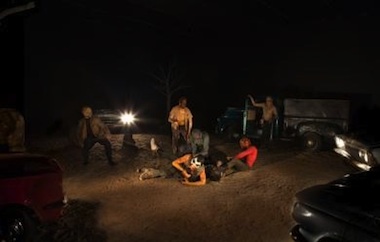
Edward Kienholz. Five Car Stud, 1969–72/2011; multi-media installation; dimensions variable. Courtesy of Los Angeles County Museum of Art. Photo: Tom Vinetz.
exhibition. Chris Burden’s The Reason for the Neutron Bomb (1979) and Eleanor Antin’s The Nurse and the Hijackers (1977) have ample room to breathe, while Betye Saar’s Secrets and Revelations (1980/2011) and John Outterbridge’s Broken Dance, Ethnic Heritage Group (1978–82) are given inappropriate, awkward treatment in corners next to exit doors. (Luckily, both Saar and Outterbridge have an excellent showing in the Hammer Museum’s PST exhibition, Now Dig This!, and Outterbridge’s solo exhibition at LAXART is not to be missed.) Other works that escape suffocation are a smartly grouped set of engaging works by Ilene Segalove, including The Mom Tapes (1974–78) and Carl Cheng’s Natural Museum of Modern Art (1979–80), a coin-operated public artwork originally installed at the Santa Monica Pier. For the price of a quarter, it quietly invites individuals to patronize the creation of an abstract sand sculpture through a sophisticated, mechanized system. It is, in the midst of the dystopian spirit of much of the other work included at MOCA, a reminder of another, more hopeful spirit from that period—both of which PST aims to resurrect.
Pacific Standard Time is on view at various locations throughout Southern California through February 2012.
Edward Kienholz: Five Car Stud 1969–1972, Revisited is on view at Los Angeles County Museum of Art through January 15, 2012.
Under the Big Black Sun: California Art 1974–1981 is on view at Museum of Contemporary Art in Los Angeles through February 13, 2012.
Susannah Magers is an independent curator currently based in San Francisco. She recently earned her master's degree in Curatorial Practice from the California College of the Arts.