
3.2 / Review
From Beijing: The Peach Colony
October 4, 2011A fisherman follows the course of a stream one day and discovers a blooming peach tree grove that leads to a secret path and a magical land. A sanctuary for those who had fled the tyranny of the Qin emperor, the land is full of cheerful and contented people. This is the story of The Peach Colony, Tao Yuanming's famous Song dynasty poem and the inspiration for Yang Yongliang’s exhibition of the same name, currently on view at Galerie Paris-Beijing.
Yongliang’s intricately detailed black-and-white images, assembled from lots of smaller photo clips, at first appear to be taking this subject quite literally. Men in long white robes wander and meditate among trees and streams or in valleys surrounded by craggy mountains. Yongliang’s idealized photographic landscapes recall those of traditional Chinese paintings. Viewers may be seduced, but closer inspection reveals mountains populated by masses of tiny digitally manipulated skyscrapers—piles and piles of them, like skyscraper-favelas reaching into the sky. The valleys are, in fact, industrial wastelands, scattered with disused machinery parts and glutted with swamps. The vivid environments conjured by the artist are entirely artificial. They are masterpieces of Photoshop wizardry, carefully crafted together from small cutouts of digital photographs to create large, sometimes vast, prints with Hieronymous Bosch-scale detail.
But Yongliang’s images are more dystopian than hellish. With the exhibition’s references to Tao’s poem and traditional Chinese art, the artist seems to warn of the destruction not only of the environment, but also of the past; Tao’s magical sanctuary has been corrupted. In the light of China’s exponential growth and increasing urbanization, Yongliang’s work seems to register anxiety about what is being lost. During a short trip to Beijing, I saw evidence everywhere of the rate at which the old Chinese hutongs are being demolished, and modern apartment complexes erected. Yongliang takes this notion to the extreme in Infinite Landscape (2011), in which there is no area of land that is left undeveloped. Projected in its own gallery room, this stop-motion animation depicts an industrial city situated around a few mountains. Cars move continuously along snaking freeways, a zeppelin flies overhead, and the occasional explosion is a reminder of the unending destruction necessary to keep this city’s machinery fuelled.
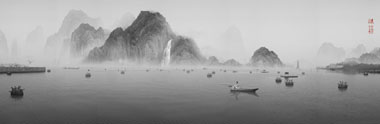
Lonely Angler, 2011; digital photographic collage; 32 x 97 in. ©2001 Yang Yongliang/Galerie Paris-Beijing.
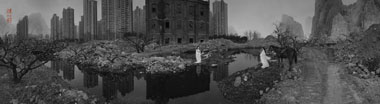
Ode to the Goddess of Luo River, 2011; digital photographic collage; 37 x 138 in. ©2011 Yang Yongliang/Galerie Paris-Beijing.
Perhaps the bleakest of the images on display is The Lonely Angler (2011), in which a fisherman sits alone in his boat and hangs his line into a still black lake—apparently lifeless and peppered with ominous-looking, spiked buoys. True to its title, the image evokes feelings of loneliness and hopelessness; the buoys are like red flags, warning of the lake’s inhospitable environment. It seems unlikely that anything lives here, let alone enough to provide a catch for the fisherman. People scarcely figure in Yongliang’s landscapes, but their presences are felt all the more for his austere backdrops. In Ode to the Goddess of Luo River (2011), a man and a woman stand across from each other on either side of a river running through a rocky wasteland with skyscrapers and ruins silhouetted against a gray sky. Rather than detracting from the romantic tension between these two figures, the inert landscape appears to heighten it, setting them into relief against a lonely world.
Yongliang’s approach to his subject is hardly subtle—turning a once-wild landscape into an urban wasteland seems an obvious tactic. But the artist’s execution and meticulous construction imbue the images with sensitivity. The place of the individual within these apocalyptic visions, and the strange aesthetic they possess, makes them compelling. Even in Heavenly City (2008), in which factory fumes resembling an atomic mushroom cloud spew out cranes, bridges, roads, and other industrial apparatuses, the proportions and composition of the image are so balanced, and the tones so rich in texture, that they produce a paradoxically beautiful image. Yongliang's vivid and surreal collages first lure in viewers, then confront them with their true, shocking content. And yet, a sense of feng shui in these landscapes somehow remains intact.
In many ways, Yongliang’s subject may be a cliché to the Western eye—contemporary art is awash with ruin-porn, and readymades constructed from recycled objects have been on the art market for decades. However, on the basis of a three-day exploration of Beijing’s arts districts, I would argue that environmental concerns are increasingly present in contemporary Chinese art and aligned with a burgeoning ecological consciousness. But is there something beyond cliché that Western viewers can take away from these images? The Slovenian philosopher Slavoj Žižek, for example, believing that our alienation from waste is part of the environmentalist’s problem, urges consumers to find some aesthetic value, even poetry and spirituality, in detritus. Perhaps Yongliang’s works propose a similar such reconfiguration of beauty through waste.