
Shotgun Review
Francesca Woodman
December 6, 2011Though she participated in only a handful of exhibitions during her lifetime, Francesca Woodman has been the subject of five major monographic exhibitions since her death in 1981. It’s tempting to evaluate Woodman’s work biographically, to root the poignancy of her work in her suicide at age twenty-two and to credit her current fame to her parents’ art-world connections. Yet to so summarily dismiss this retrospective-like exhibition of Woodman’s work would be brash. Drawn largely from her undergraduate years at Rhode Island School of Design from 1975 to 1978, Woodman’s photographs draw their strength and allure precisely from their exploratory, inchoate nature, possessing all the expectancy and contradiction of youth.
She was an artist of her time, and many of her black-and-white, mostly nude self-portraits employ familiar strategies of feminist artists from the 1960s and ’70s, as she used her own body—pinched, painted, hidden, and exposed—to examine female subjectivity. Concurrent with a burgeoning critical discourse surrounding the medium, Woodman’s photography is self-referential, grappling with light and shadow, the imprint of the female form, and the construction of identity itself.
Among these recognizable dialogues, however, is something more enigmatic, more personal, and ultimately more alluring. In the space of a decaying Victorian house, Woodman posed nude or clothed, and appears often as a blur of movement, half hidden by a fireplace or swath of wallpaper. She resembles a child hiding and a self-possessed woman, at times ethereal, like Alice after she’s passed through the looking glass, both trapped by and master of her crumbling surroundings. Often she meets the gaze of the camera, and just as often her face is eclipsed in a blur. Some images are scrawled with diaristic inscriptions. In one untitled study, three nude women stand wearing masks of the artist’s face. In a video shot in her studio, Woodman writes her name across a large sheet of paper, then slowly tears it apart to reveal her naked body behind.
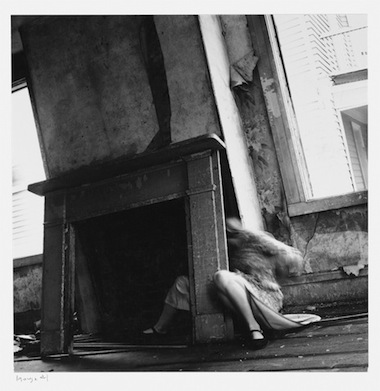
House #4, Providence, Rhode Island, 1976; gelatin silver print; 5 ¾ x 5 ¾ in. Courtesy George and Betty Woodman; © George and Betty Woodman.
Woodman’s is an unformed oeuvre of disparate glances, not a honed argument. We can speculate about the direction her art might have taken in maturity, but what is more interesting is the puzzle we discover by looking; the fertile space of liminality—a girl-woman on the cusp of adulthood—whose struggles still resonate today. In these remarkable photographs, we see Woodman grappling with her own body, how it is perceived, how it fits in space, and how it can express the mind within.
Francesca Woodman is on view at the San Francisco Museum of Modern Art through February 20, 2012.
Lauren Schell Dickens is an independent curator, and now writer, currently living in San Francisco.