
Shotgun Review
Ever After
October 3, 2011So, what is a mausoleum to do with that pesky extra space yet to be rented for all of eternity? The Chapel of the Chimes temporarily opened some of its real estate for utilization by local artists, allowing its few empty niches to operate as ad hoc installation spaces scattered throughout its otherwise packed walls of monogrammed ashes and personal keepsakes. The result is Ever After, which installs the work of thirteen artists throughout Julia Morgan’s historic building.
The front desk offers a map with locations of the artists’ works, but unplanned meandering permits viewers to linger over occupied niches that are particularly artful in their own right. The urns of the deceased lie within tenderly prepared curio cabinets full of everyday possessions, from bank books to pipes to personal journals—all of the items to be emptied out of one’s pockets upon returning home at the end of the day. Each everyday object now sits carefully arranged next to its owner’s remains. Some artists in Ever After riff off this display of the everyday, quietly blending in with the Chapel’s permanent inhabitants. Phil King’s installation Frames (2011), for example, appears to be just a simple pair of glasses placed in an empty niche, yet the work has a haunting reverberation. Though it is the only object that remains anonymous within a wall replete with engraved markers of ownership, its shape bears the slight bend of regular use, the personalized form that results from the unknown individual’s repeated wear.
Andrew Witrak’s Dixie Cup Phone (2011) makes apt use of the glass divide between an interned loved one and living visitors. A paper cup hangs from a string threaded through a small hole drilled in the glass partition, which is tied to another paper cup lying on the interior of the niche’s floor. By utilizing a child’s tool for covert conversation, Witrak is able to both playfully and tenderly address the often saccharine and overused notion of communication with the “other side.”
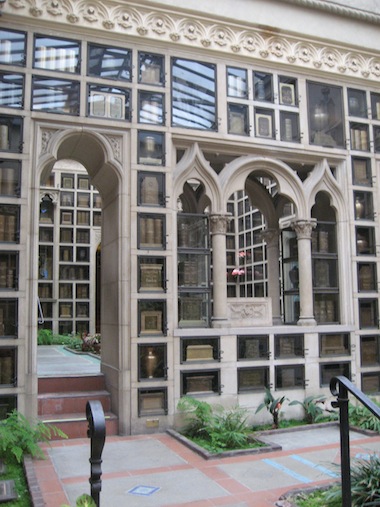
Exterior view, Chapel of the Chimes, Oakland, 2011. Photo: Lia Wilson
Two artists had their works removed from the chapel due to complaints from visiting patrons. The impact of those absent works is not diminished, though: in an already conceptually and emotionally loaded environment, their removal serves as a reminder of the human tendency to impose limits on reflections of death, as well as the need to curtail what we are willing to ponder or confront.
Ever After is on view at the Chapel of the Chimes, in Oakland, through November 13, 2011.
Lia Wilson is a writer and arts education administrator living and working in San Francisco. She holds an MA in Visual and Critical Studies from the California College of the Arts and a BFA in Printmaking from the College of Santa Fe.