
Shotgun Review
E is for Everyone: Celebrating Sister Corita
February 21, 2011Sister Corita Kent lived a life as intriguing and anomalous as her career as a pop artist would indicate. A nun, community leader, teacher, and activist who left the convent to pursue her passion for modern art, Kent attended art school in L.A., found a mentor in Charles Eames, and became a rare modern artist capable of merging the conventions of Pop Art with a spirit of activism and brotherly love. She incorporates the graphics of mid-century modernism, the reverence of the convent, the pedagogy of the educator, and the rhetoric of activist art to constitute a unique brand of Pop Art. A retrospective of her work entitled E is for Everyone: Celebrating Sister Corita includes a selection of her print work, the spectacular films of Ray and Charles Eames, two memorial documentaries, and reproductions of her correspondence with Charles Eames.
The show manages to demonstrate Kent’s full range of messages and graphic styles despite the intimate size of the museum. Some of the featured prints scream powerful anti-war sentiments such as in E eye love (1968): “[Eye] should like to be able to love my country and still love justice—Camus.” Others whisper messages ranging from simple pleas for peace, such as Tender Be (1965), to pious messages aimed at community organization. In the piece entitled if (1965), Kent asks “what does it mean to be a Christian? What does it mean to be a human?” In contrast to these weighty themes are more playful, bluntly worded phrases, as in the case of Damn Everything But the Circus (1968). Despite this range of content, bold graphics and her allegiance to the aesthetics of advertising manage to visually unite the diversity of her convictions.
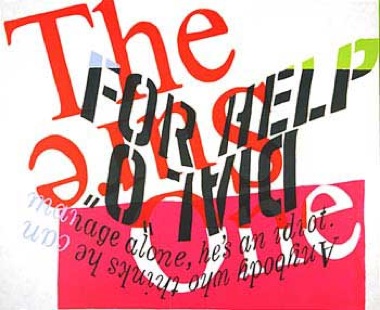
the sure one (1966), serigraph. Courtesy of Corita Art Center, Los Angeles.
Though the combination of Pop Art and spirituality seems unorthodox, this contradictory convergence of the tropes of advertising, graffiti, Pop Art, activism, and spirituality appear to seamlessly organize themselves within the simplicity of her painterly prints. The force of her messages provides depth, authenticity, and religion to a flat medium, flushing away any ironic allusions to the superficiality of Pop Art and advertising. What remains of these genres is their appeal to the everyman. The set of coded instructions to the masses inherent in advertising and print media are decoded, reassessed, and translated into humble messages of community leadership, character, and love.
E is for Everyone: Celebrating Sister Corita is on view at the Museum of Craft and Folk Art, in San Francisco, through June 5.
Luam Melake is a recent UC Berkeley graduate who holds a BA in architecture and a minor in art history. She works in San Francisco as a bookseller of art and architectural materials.