
Shotgun Review
Collecting Memories
September 14, 2010Since graduating from the powerhouse MFA program at Stanford in 2004, Binh Danh has quickly been elevated to regional—bordering on national—renown. He was in the California Biennial at the Orange County Museum of Art in 2006 and in One Way or Another: Asian American Art Now, a noted group show that toured the country that same year into 2007. The exhibition at Oakland’s Mills College Art Museum, titled Collecting Memories, might be the largest of his career, and affords us an opportunity to reflect on this notable success.
The show is in three consecutive galleries and is made up of five different bodies of work. In the first, we see an array of some four dozen of his signature chlorophyll prints. Large, tropical leafs in arrowhead shapes, displayed point-up, have been manipulated to have camouflage patterns. There is also a set of three portraits of GIs executed on grass, like images emerging from shredded paper; we assume that they were participants in the Vietnam War. The next room contains documentary photography taken recently of sites of conflict from forty odd years ago. In cases in the center of the room are old Life magazines reporting on the war, among which are publications of Vietnam Veterans Against the War (VVAW) and a small Vietnamese-language brochure. There are also
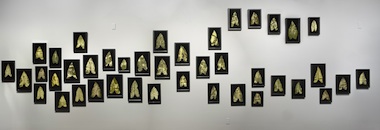
Binh Danh. Military Foliage (detail), 2010; sixty-six chlorophyll prints in resin. Courtesy of the Artist and Haines Gallery, San Francisco. Photo: Paul Kuroda.
three large photographic portraits of young monks. The third room is filled with daguerreotypes in glass: twenty-eight prints and four books, all of scenes both of the war and of the same sites now.
Danh’s acclaim can be attributed in part to his immaculate craftsmanship; everything he makes is of the highest standards of conception and execution. This perfectionism is greatly attractive to both collectors and museums, if only because of its rarity in contemporary art, when so many artists reject the values of cleanliness and refinement. His recurring theme, that the tragedy of war is that its ramifications are enormous and only partially understood even as time passes, is serious enough for many. Others seeking investigations of neocolonialism and psychology, who prefer more open-ended and less romantic approaches, need look elsewhere, as in the nuanced and complex work of an artist like filmmaker Trinh Minh-ha.