Shotgun Review
Be Here Now
April 21, 2010In a recent online interview with Courtney Dailey, artist Libby Black laid out her artistic stance: People always want me to love or hate the objects I am making, or the culture that loves or hates them. But for me, it is not either-or. People want me to have a clear stance, be hyper-political about the fashion world, and I both am and I am not. I don't feel I need to pick sides.1 To understand Black's art, one cannot stop at the reading of her work as crafty copying of the fashion pages. The full impact of her sculptures and drawings lies within the very paradigms and idiosyncrasies of our times. Artists are consumers themselves. They have their own elaborately constructed systems of valuation as subsets within larger realms of consumer value. No art is absolutely pure, or created in a vacuum outside those larger realms.
Black addresses such dilemmas, ironies, and contradictions unabashedly and artfully in Be Here Now, her current exhibition at Marx & Zavattero. Her sculptures are either banal copies of luxury commodity objects, or unflinching mirrors of our own desires and philosophies. They seem to hold the truth that the artist kindly points out; they don’t feel they need to pick sides. The works become more political if they don’t take determined stances, and they also become more attractive from a consumerist view as well.
In Me and Bobby McGee (2010), a rare self-portrait, the artist styles herself according to the iconic black-and-white photo of the late, great soul rocker Janis Joplin. The artist relates to Joplin as a fellow Texan who embraced an alternative lifestyle sexually and politically. Self-portraits are not only set forth for our consideration, but can also be illustrations of the artist considering us. The series of photos of Joplin from which this image is drawn are of a stoned and sometimes smiling rock star. In contrast, Black stares at us quizzically, baring her soul as well as her torso; her eyes are neither accusing nor aloof. She appears to be gazing at us with a look of honesty.
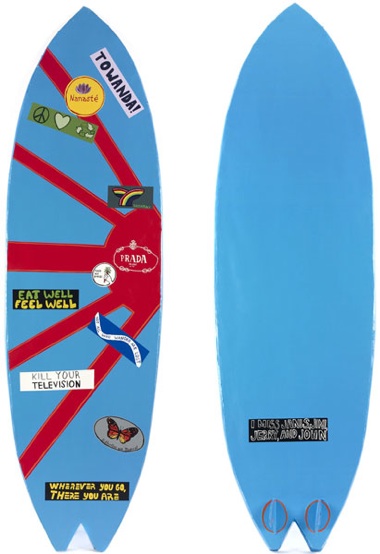 Prada Surfboard, 2010; paper, hot glue, and acrylic; 69 x 20 x 7.5 in. Courtesy of the Artist and Marx & Zavattero, San Francisco.
Leaning on the gallery wall is Prada Surfboard (2010). The painted paper construction calls attention via its title to the Prada sticker that is surrounded by familiar liberal countercultural bumper stickers, including ones that say Namaste, Greenpeace, Food not Bombs, and Kill your TV. Black suggests these are all slogans of luxury, affording a certain set of understandings that come from privilege, and therefore create their own self-styled label. In sum, the counterculture Black discusses might equally be found at Macy's or in the minds of artists. Hers should not be missed.
Be Here Now is on view at Marx & Zavattero in San Francisco through April 24, 2010.
________
NOTES:
[1] http://blog.thequeerist.com/2010/03/libby-black-more-than-fake/