
Shotgun Review
0-Viewpoint
June 16, 2010Stella Zhang’s current exhibition at the Chinese Culture Center, “0-Viewpoint,” is worth one's time. Zhang’s deeply personal presence is meditative without being sugarcoated. The zero, if taken at face value, implies that no viewpoint is offered. However, this is art and Zhang is an accomplished artist. Hers is a dialogue framed by cultural dichotomies, a willingness to explore vulnerability, and visualization of the feminine sublime.
The installation piece 0-Viewpoint·1 (2010) is composed of a crowd of giant phallic statues made from white material stretched over barely visible metal structures. Behind the delicate folds and elegantly pleated surface one can glimpse an inner landscape. One can almost hear viewpoints inside the minds of these figures void of expression.
0-Viewpoint·2 (2010) features ruptured, urchin-like body parts floating on monofilaments inside a luscious circle of sheer white fabric just above the gallery floor. Pierced by wooden skewers, their shadows seem to breathe in pain and exhale relief. Another portion of the installation displays objects made from seat cushions in which elliptical crowns of skewers penetrate the surface. It features folds and gashes similar in shape to vulvas. Do these formal interventions express Zhang’s struggle for differentiation or consequences of an expression of a viewpoint?
0-Viewpoint·5 (2010) is a series of twelve canvases honoring a woman’s monthly cycle. The canvases evoke albino enso (the Zen circle, a central symbol of the Zen calligraphic tradition) that substitute glue for sumi-e ink. Each stretched enso is an ovoid shape with an orifice. The clear mark varies in texture and tone by the addition of sand. Like a Rorschach test, some recall ultrasonic imagery while others conjure wise elders. The
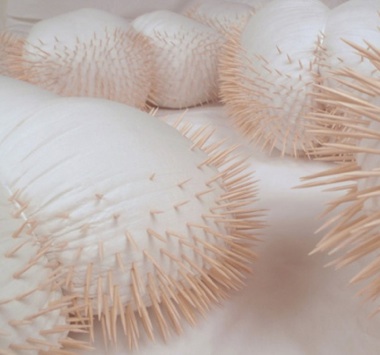
0-Viewpoint·2, 2010; toothpicks and fabric; dim. variable. Courtesy of the Artist and the Chinese Culture Center.
colonnade of canvases hangs below a canopy of white material stretched like synoptic dendrites. At the terminus, a sleeve of material cascades down onto the gallery floor, creating a powerful inducement to enter the art.
Though Zhang’s previous work demonstrates mastery of color, texture, and materiality, she exclusively uses white in this exhibition. The cultural attribute of the color white highlights tensions faced by Zhang, who was born in Beijing, lived in Japan, and now resides in Palo Alto. In Western lore, white signifies virginity and unmarked potential, whereas in Eastern culture, death and emptiness are assigned to the color. The genesis of Zhang’s forthright decision may portray a yearning for cultural reconciliation.
“0-Viewpoint” is on view at the Chinese Culture Center in San Francisco through September 5, 2010.
Carol Koffel uses porcelain and found objects to express the hand, heart, and mind as a catalyst for change.