1.3 / Binaries
Drifting and Navigating, Part 1
November 18, 2009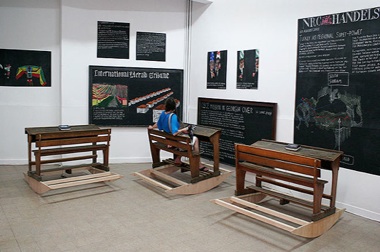
Not Going the Distance: Reflections on Bertolt Brecht and Binary Thinking Brought up in the 11th International Istanbul Biennial.
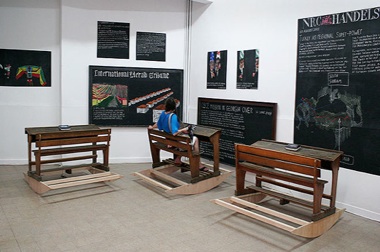 Lado Darakhvelidze. Ideal Media, 2008-09; chalk drawings, blackboards, school desks, wooden rockers. Photo courtesy of Jaana Prüss.
However, there is a problem with bringing Brecht back—though I am pretty sure he never left—and utilizing his strategies that resonates throughout this biennial. The problem is not one of asking artists to consider art production as part of a collective, political, or educative activity, nor is it really a problem to ask viewers—or more specifically, the cultural producers addressed in their curatorial statement—to be critical about our life and our political situation. Obviously, sometimes we need reminders. The problem lies in the binary moralism of Brechtian strategies, which do not actually help us to change the world, but actually stultify us because they reassert a hierarchy, a distance, and a limit between those who know and those who lack knowledge.
In their use of direct address and aims to make the audience self-aware, Brechtian strategies confront us with provocative and partial moral facts that are typically exaggerated, shown immense in size and dire in consequence, made clearly visible, and offer little recourse. In this Biennial, confronted with the question “What keeps mankind alive?” we have no answer. In its magnitude, this irresolvable question only lays a burden on us. It seems to demand justification for our existence, and creates the implication that humankind is bad or wrong. This implication weighs like guilt on us, and frames a negative perception around life and art throughout the exhibition. I don’t find guilt to be a radical strategy. It does not help to educate, quite the opposite in fact. It burdens and restricts freedom to explore and investigate. This guilt is a product of moral binaries—a system that asserts a separation between two ideas or experiences. It perpetuates an immense distance, which in its magnitude appears to be untraversable.
Despite the curators’ interest in other aims and ways of artists working, such as through collective production, education and political activism, their reassertion of Brechtian binary strategies keeps art separate from these goals, and these methods separate from each other. They are seen as models of working, separate systems with which artists can engage rather than already inherent components of art. If they acknowledge that art functions or would like to see it function in these inherently horizontal ways of working —educative, collective, activist—they must also realize they are antithetical to the innate hierarchical verticality of a binary model.
But perhaps I am moving ahead too fast, so I will take a moment to consider the subject of Brecht and the reasons behind his approach, to discover the roots of his binary tactics and how his method imposes unintentional limitations on his audience.
It is important to consider Brecht’s ideas in relation to his time. Although he was an unquestionable innovator of the stage and drama theory, he was also reacting to a very specific and charged moment. He saw his country live through two savage wars, one in which it seemed all of Germany turned towards totalitarian fascism, anti-Semitism, racism, brutal discrimination, and just about every negative attitude one can imagine. He also saw Germany suffer through massive unemployment and economic collapse. Fearing persecution, he fled his country only to be persecuted by the House Un-American Activities Committee while in asylum. Finally, he saw his ideological allegiances shift and tarnish when the increasingly totalitarian and repressive polices of Stalinist socialism that began in the 1930’s dashed his Marxist hopes for equality and change. Brecht’s ideas, his moralism, and his commanding approaches need to be seen in light of these experiences. They are guided by his anger at the direction the world was heading and those that allowed it to happen.
It was Brecht’s aim that his plays function as moral learning tools to incite the audience to liberate themselves and change society, or in his words, to allow the spectator to “achieve his own theatre which will help him to master not only himself but also the world.”5 But Brecht was cautious about losing the moral lesson of his plays in the pleasure or entertainment of the theatrical experience, arguing that pleasure could very quickly become a distraction from the real political task of theater to educate for change. Brecht drew a division between two separate courses in theater: entertainment and education.
Always favoring the latter, he organized his plays as presentations of moral lessons and political provocations, directing the “already distracted” viewer to concentrate, learn, and act. However, this emphasis on a binary vision of a theater opened up a gap that limited pleasurable education or educational pleasure, and emphasized the playwright as the teacher of the moral lesson to the distracted audience. As a result, we understand Brecht as a didactic playwright.
The word didactic evokes a person who advances a kind of pedantic and forced education, emphasizing rules and rote learning, like a strict schoolmaster with ruler in hand, ready to curtail any sign of fun, or anything that deviates from the lesson. By consequence, the term also refers to a teacher who does not view the student to be of equal intelligence, or in this case, the audience to be of equal moral understanding. Therefore, the teacher forces their knowledge—factual or moral—upon the student, instructing with little room for fun and the pleasurable experience of learning. A didactic approach might be similar to what the philosopher and educator Paulo Freire has referred to as the “banking form of education” in Pedagogy of the Oppressed. Banking is teaching, “in which the scope of action allowed to the students extends only as far as receiving, filing, and storing the deposits.”6 The student is provided with information, but not the tools to discover more. Freire suggests that many didactic or banking approaches to education constantly reassert a hierarchy, a division between the teacher as the one who knows and the student as the one who lacks knowledge. It restricts movement, to paraphrase Freire, by anesthetizing and inhibiting creative power.7 This approach removes experimentation, pleasure, and entertainment from the educational experience. It restricts the student’s potential to learn and act. This is their political potential.
Freire proposes reconciling the poles of the teacher-student contradiction by equalizing their respective positions and having them act simultaneously as both teachers and students. In his text, "The Emancipated Spectator," the French philosopher Jacques Rancière parallels this sentiment when he says that the teacher must meet the student halfway. Rancière writes that the teacher “does not teach his knowledge to the students. He commands them to venture forth in the forest, to tell what they see, what they think of what they have seen, to check it and so on. What he ignores is the gap between two intelligences.”8 This gap is the same distance or separation that is promoted in the conception of a student as a passive receptacle and teacher as active agent. It is the same one that exists in Brecht’s alienation effect, which sees a separation between the pleasure of the theatrical experience and the moral lesson. And it is the same gap that we feel between the problems of the world and our ability to solve them that leaves us guilt-ridden and helpless. A gap only delineates different subjects or different subjectivities—ways of experiencing something. It does not mean that these subjects or subjectivities need to be separated or treated as detached. When the latter happens, the gap becomes un-traversable and therefore fixed, and limits the potential for dialog or learning in concert.
 Questionaire distributed after Bertolt Brecht's The Measure (1967), which was reprinted and placed on two empty school desks, with pencils, in the attic of the Tobacco Warehouse, one of the three main sites of the Eleventh Istanbul Biennial.
As I have stated above, Brechtian approaches, for all their good intentions, reassert such a gap in knowledge and experience. They are not actually edifying in the sense of teaching one, as Brecht aspired, how to achieve their own theater and master the world. In fact, they stultify, reasserting an imbalance between those who know and those who don’t know, between those who have power and those that lack it. They are simply more dominating than they are emancipating. This Istanbul Biennial’s embrace of Brechtian strategies perpetuates these gaps, hierarchies, and imbalances for the sake of clear political positioning, making our experience of the Biennial both a negative and a powerless one.
In looking for a possible solution to overcome these binary positions, I will turn to the theorist and political philosopher Michael Hardt, known for a trilogy of books readdressing capitalism and Marxism written with the Marxist philosopher and social theorist Antoni Negri. In an interview, Hardt discusses politics or activism, which, like Brecht’s theater of education, is seen as a typically moralizing project. Hardt felt that politics and activism are also disciplines that are surrounded by guilt of exclusion, driven by a quest for purity. But he discovered another kind of politics, one similar to what Freire and Rancière both speak about, a politics not driven by hierarchical forms of instruction, but by the pleasurable experience of learning to live better together. Hardt says, “I remember thinking about politics, rather than as an ascetic redistribution, as a collective project for the increase of joy.”9
This marriage of politics and joy places the curators’ methods in stark contrast. Beyond their intentions to think about art politically, and to consider our present economic and social conditions, they reassert a gap between experiences. With it, they instill guilt at the inability to traverse that space. If it is our aim to consider politics and art as part of the same project, then we cannot do it by reasserting the distance between teacher and student, education and pleasure, or politics and art, or even our medium and its goal, for they are part of the same project and process. Perhaps the most radical political project would be to consider art as political, and pleasure as edifying. Then we may be able to see how these things can work in concert, as active political processes of learning and teaching without distance, as collective projects for the increase of joy.